









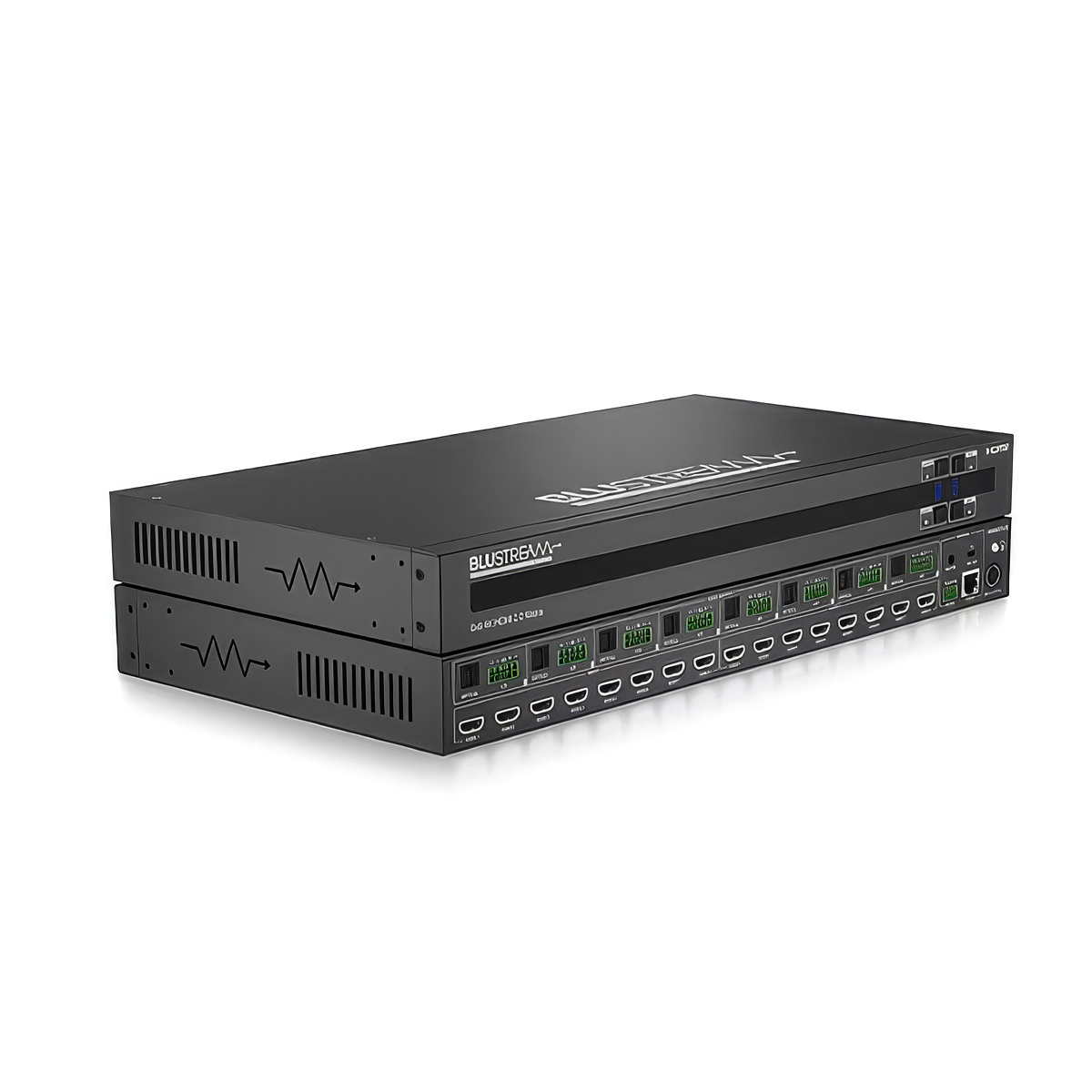

The Blustream CMX88CS-V2 is an 8x8 HDMI 2.0 matrix switcher that distributes video and audio from eight HDMI sources to eight independent displays. Supporting resolutions up to 4K UHD at 60Hz with 4:4:4 chroma sampling, HDR and HDCP 2.2, it provides flexible source routing for professional audiovisual installations, meeting rooms, hospitality venues and multi-screen entertainment systems. Integrated audio breakout, advanced EDID management and independent video down-conversion help accommodate different display capabilities, while multiple control options allow convenient operation within a wider AV system.
Key Features of Blustream CMX88CS-V2
Features 8 x HDMI inputs which can be independently routed to 8 x HDMI outputs
Supports HDMI 2.0 18Gbps specification including HDR
Supports up to 4K UHD 60Hz 4:4:4
Video down-conversion on outputs allowing a display only capable of supporting lower video resolutions (4K 60Hz 4:2:0 or 1080p) to receive 4K 60Hz 4:4:4 video content while still showing maximum original 4K UHD resolution on remaining video outputs
Supports all industry standard video resolutions including VGA-WUXGA and 480i-4K
Supports bitstream passthrough of multichannel surround sound including object-based audio formats in line with HDMI specifications
HDMI zone audio breakout to balanced/unbalanced analogue L/R audio and optical digital outputs concurrently
Control via front panel, IR, RS-232, TCP/IP and web GUI
Independent IR routing capabilities
Supplied with Blustream 5V IR receivers and emitters
3rd party drivers available for major control brands
Advanced EDID management
HDCP2.2 compliant
Flexible Eight-Source Video Distribution
With eight HDMI inputs and eight HDMI outputs, this matrix switcher allows each connected source to be routed independently to the required display. This arrangement supports installations where different screens need to show separate content or share the same source. Applications include commercial displays, conference facilities, hospitality environments, control rooms and multi-zone audiovisual systems.
4K UHD and HDR Video Support
HDMI 2.0 connectivity provides bandwidth up to 18Gbps for video resolutions reaching 4K UHD at 60Hz with 4:4:4 chroma sampling. HDR support helps compatible displays reproduce a wider range of brightness and colour information. HDCP 2.2 compliance also supports playback of protected content when the connected source and display equipment meet the required specifications.
Independent Video Down-Conversion
Integrated down-conversion allows compatible outputs to deliver a lower video resolution when connected displays cannot accept the original signal format. For example, a display limited to 4K at 60Hz with 4:2:0 chroma sampling or 1080p can receive a compatible converted signal while other outputs retain the higher-resolution video. This flexibility helps accommodate mixed display specifications within the same installation.
Integrated Audio Routing and Breakout
The matrix provides optical digital and balanced or unbalanced analogue stereo audio outputs, allowing audio to be extracted for connection to amplifiers, powered speakers and other compatible equipment. Dedicated analogue audio inputs support audio embedding, while HDMI audio passthrough accommodates supported multichannel formats, including object-based surround sound. These connections offer flexibility when video displays and separate audio equipment are installed in different locations.
Multiple Control and Configuration Options
Operation is available through the front panel, infrared control, RS-232, TCP/IP and a web-based graphical interface. Advanced EDID management helps establish suitable communication between connected sources and displays, while independent IR routing supports control of source equipment in distributed installations. Third-party control drivers are available for integration with compatible AV control systems.
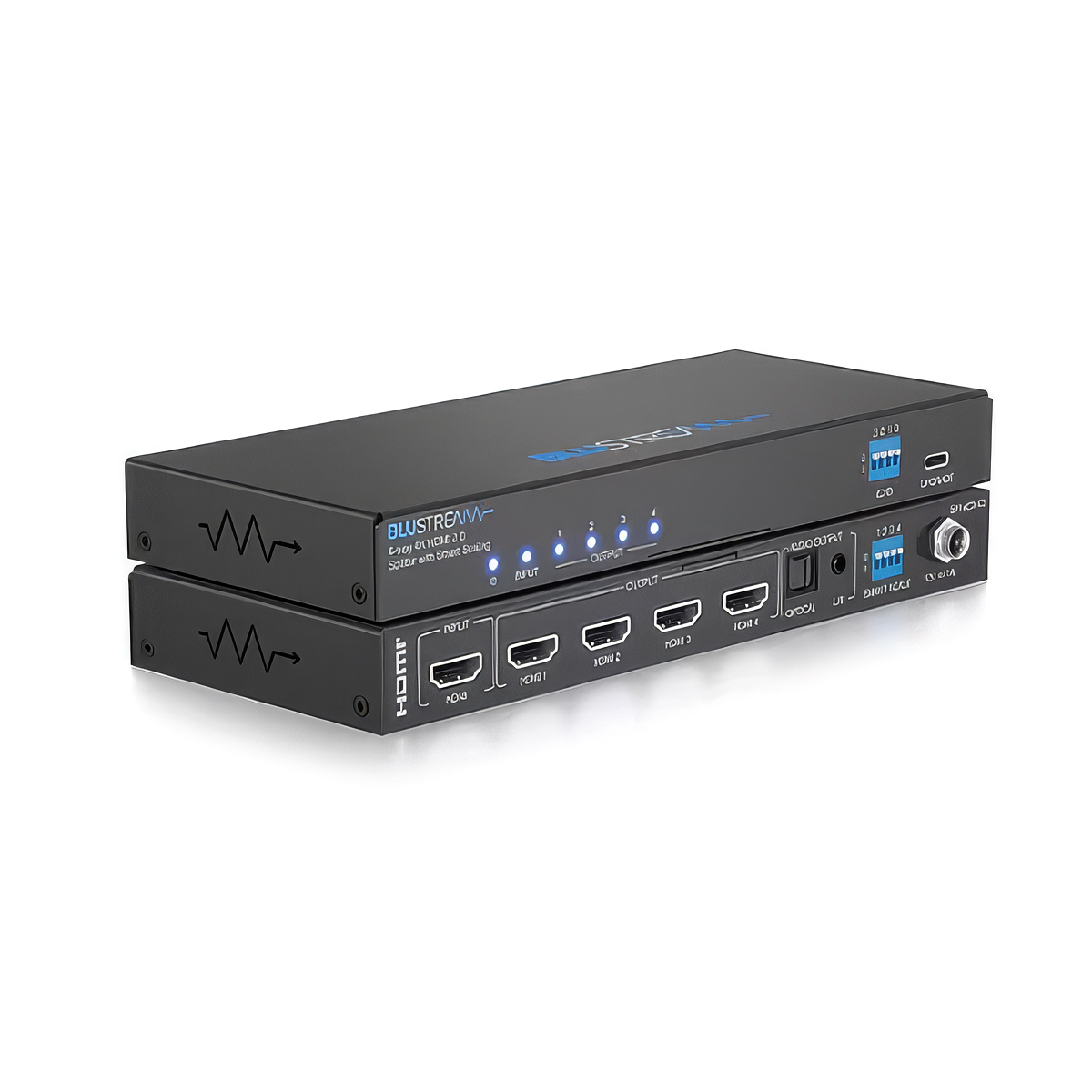
The Blustream SP14CS-V2 4-Way 4K HDMI 2.0 Splitter with Smart Scaling distributes one HDMI source to four displays simultaneously, supporting video resolutions up to 4K UHD at 60Hz with 4:4:4 chroma sampling. With HDR support, HDCP 2.2 compatibility and integrated audio breakout, it provides flexible connectivity for multi-screen AV installations.
Key Features of Blustream SP14CS-V2
1x HDMI input that is replicated to 4x HDMI outputs
Supports HDMI 2.0 18Gbps specification including HDR
Supports up to 4K UHD 60Hz 4:4:4
Video down-conversion on outputs allowing a display only capable of supporting lower video resolutions (4K 60Hz 4:2:0 or 1080p) to receive 4K 60Hz 4:4:4 video content while still showing maximum original 4K UHD resolution on remaining video outputs
Supports all industry standard video resolutions including VGA-WUXGA and 480i-4K
Supports bitstream passthrough of multichannel surround sound including object-based audio formats in line with HDMI specifications.
HDMI audio breakout to analogue L/R audio and optical digital outputs concurrently
Advanced EDID management
HDCP 2.2 Support
Four-Display HDMI Distribution
Connect a single HDMI source to as many as four screens, allowing the same video content to appear across multiple displays. This makes the splitter suitable for presentation spaces, digital signage, meeting rooms and home entertainment setups that require a shared source across several screens.
Smart Scaling for Mixed Displays
The Smart Scaling function can automatically reduce the output resolution for individual displays that cannot support the full incoming video format. Compatible screens can continue displaying the original 4K UHD signal while lower-resolution displays receive a supported format, helping accommodate different screen capabilities within the same installation.
4K UHD Video and HDR Support
Support for HDMI 2.0 bandwidth up to 18Gbps allows the splitter to handle 4K UHD video at 60Hz with 4:4:4 chroma sampling, along with HDR content. HDCP 2.2 compatibility supports playback from compatible protected content sources and displays.
Integrated Audio Breakout
In addition to HDMI audio transmission, the unit provides optical digital audio and analogue left/right stereo audio outputs. These connections allow audio to be routed to compatible external equipment, such as an audio system or amplifier, while video is distributed to the connected displays.
EDID Management and Installation
Four-pin DIP switches provide access to EDID and Smart Scale settings, allowing the input and output behaviour to be configured for the connected equipment. Its compact enclosure and included mounting kit support integration into a range of AV installations.
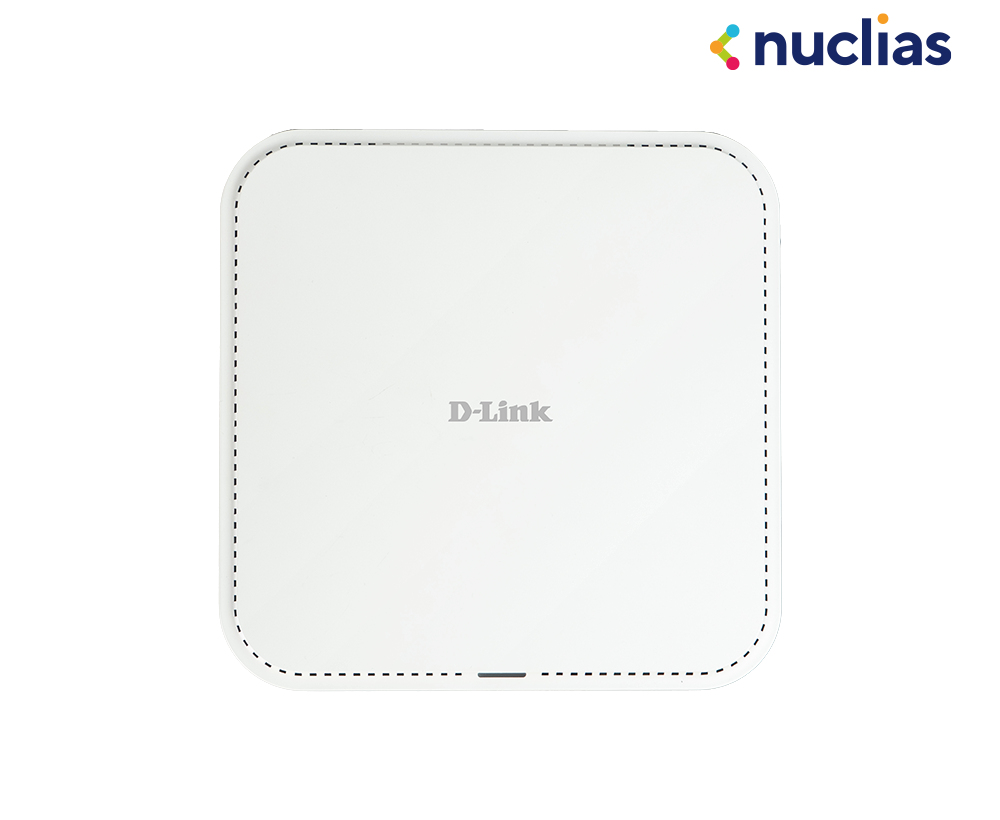

The D-Link DAP-E3620 BE3600 Wi-Fi 7 Ceiling Mount Access Point delivers dual-band wireless connectivity for offices, retail premises, hospitality venues and other business environments. Using Wi-Fi 7 technology, it provides combined wireless speeds of up to 3,570 Mbps across the 2.4 GHz and 5 GHz bands, supporting video conferencing, cloud applications and multiple connected devices. A 2.5 Gigabit Ethernet uplink with Power over Ethernet Plus (PoE+) simplifies installation, while centralised management and advanced security features support convenient network administration.
Key Features of D-Link DAP-E3620
BE3600 dual-band Wi-Fi for modern teams and offices
Reliable performance in environments
2.5GbE uplink for faster end-to-end connectivity
Simple PoE+ deployment with one-cable setup
Enterprise-grade security with WPA3 support
Easy traffic separation with VLAN-to-SSID mapping
Built-in captive portal for guest access
Flexible deployment modes for multiple scenarios
Centralized management for easy operations
Faster Wi-Fi 7 for Better Business Experiences
Dual-band Wi-Fi 7 (802.11be, BE3600 class) built for business environments — more speed, less latency, more devices.
5 GHz up to 2882 Mbps + 2.4 GHz up to 688 Mbps — combined throughput for demanding workloads, video collaboration, and dense device environments.
Multi-Link Operation (MLO) uses both bands simultaneously, cutting latency and keeping connections stable when one band is congested.
4096-QAM enables faster data transmission for smoother streaming, gaming, and downloads.
Designed for offices, hospitality, retail, and SMB deployments, it provides stable, scalable wireless performance for staff, guests, and connected devices—helping improve productivity, user experience, and operational efficiency.
Flexible Deployment for Any Network Need
Deploy in the mode that fits your infrastructure. Switch between access point, wireless bridge, or hybrid coverage without additional hardware.
Point Mode: Standard Wi-Fi coverage for wired networks — offices, classrooms, and public hotspots.
WDS with Access Point Mode (Wireless bridging + local coverage): Extends coverage wirelessly while broadcasting a local SSID — connects floors or buildings without new cabling.
WDS Mode (No AP Broadcasting): Pure wireless backhaul between two wired networks — no local SSID. Ideal for linking switches, cameras, or servers across sites.
High-Speed 2.5GbE PoE+ Uplink — No Wired Bottleneck
Full Wi-Fi 7 throughput — the 2.5GbE uplink matches wireless capacity so your wired network never limits wireless performance.
Single cable for power and data — IEEE 802.3at PoE+ eliminates the need for a separate power adapter, simplifying installation anywhere a switch port can reach.
Simplified Centralized Network Management
The DAP-E3620 integrates seamlessly with D-Link Nuclias Unity and Nuclias hardware and software controllers, including the DNH-1000 and DNC-5000, to streamline Wi-Fi management for growing business networks.
Provision, update, and troubleshoot remotely — enforce SSID and VLAN policies, push firmware, and health monitoring without visiting each site.
Scale from one AP to multi-site deployments through a single intuitive dashboard with consistent performance and security.
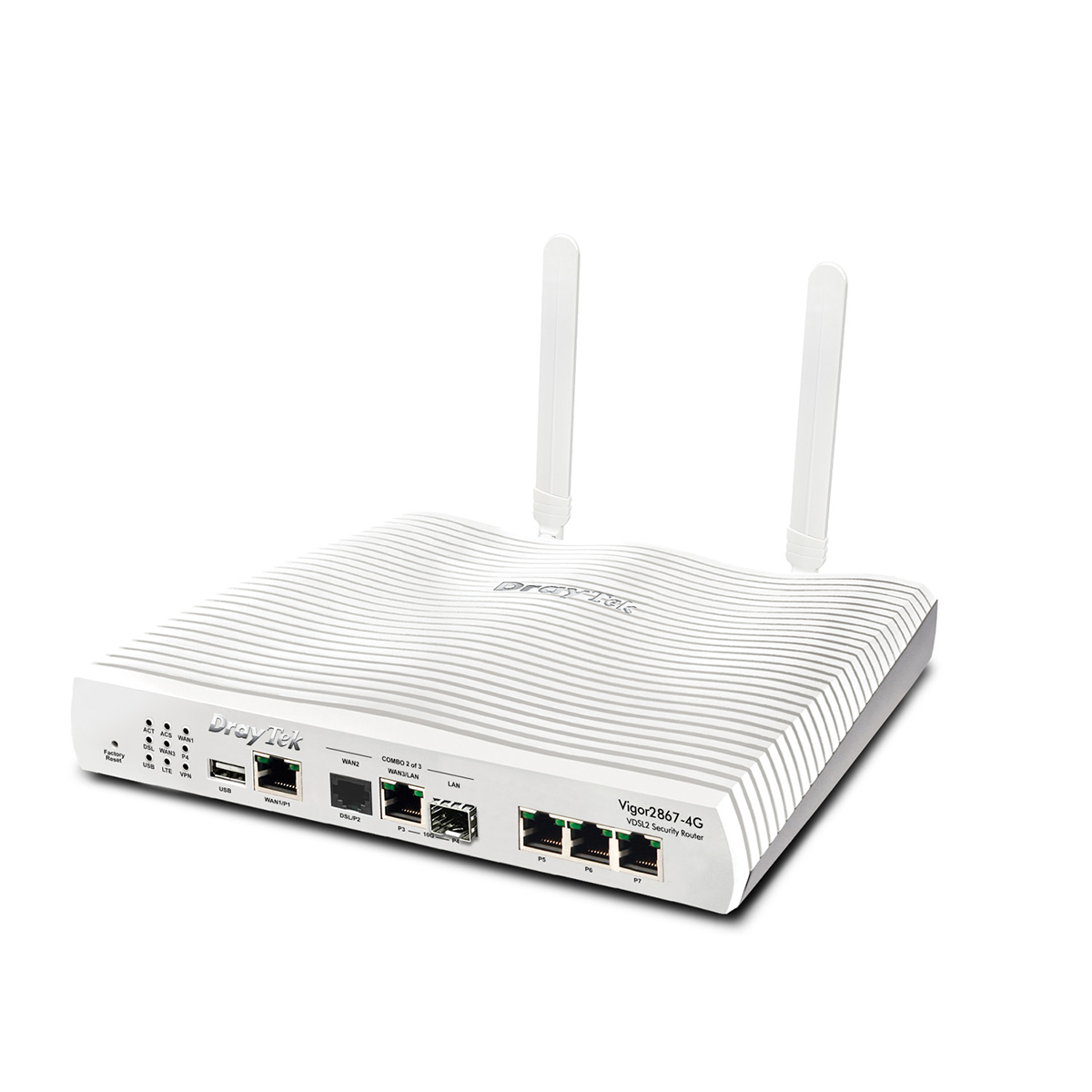

The DrayTek Vigor V2867-4G-K Multi-Gigabit Multi-WAN VDSL and FTTP Firewall VPN Router provides flexible internet connectivity for small and medium-sized businesses, branch offices and professional networks. Supporting VDSL broadband and high-speed Ethernet WAN connections, it combines multi-WAN load balancing, automatic failover, advanced firewall controls and secure VPN connectivity. Multi-gigabit networking, VLAN support and centralised management capabilities give network administrators greater control over traffic, access permissions and connected devices.
Key Features of DrayTek V2867-4G-K
Multi-WAN xDSL and Ethernet FTTP Router with Failover and Load Balancing
4G / LTE with Dual-SIM slots and eSIM support
10 Gigabit Ethernet Port for future-proof connectivity
Up to 9.1Gbps Total Maximum Throughput
Up to 540Mbps IPsec VPN Throughput
50 LAN-to-LAN & Remote Teleworker VPN Tunnels
Switchable 10GbE/SFP+ and dedicated 3x GbE RJ-45 LAN Ports
QoS and VLAN support for traffic prioritisation and network segmentation
SPI Firewall and Content Filtering
High-Performance VPN
Supports up to 50 VPN tunnels with 540Mbps IPsec throughput. Ideal for secure remote access and connecting multiple offices seamlessly.
Benefits: Secure remote access. Scalable for multiple users.
Always-On Cellular Connectivity
Integrated cellular modem with SIM and eSIM support enables flexible Internet access wherever your business operates. Automatic failover keeps you connected if the primary connection is unavailable.
Benefits: Rapid deployment. Primary and failover WAN connectivity.
Advanced Firewall & Content Filtering
Integrated SPI firewall, DoS protection, and content filters keep your network safe while controlling access and blocking unwanted content.
Benefits: Enhanched network security. Flexible content management.
Flexible Standalone or Centralised Management
Operate the router independently or manage multiple devices via VigorACS for streamlined monitoring and control.
Benefits: Easy management. Scalable for growing networks.
Multi-WAN VDSL & FTTP 10Gb Router
Fully compatible FTTP router with a 10Gb-ready interface and built-in xDSL modem. Delivers up to 9.1Gbps with firewall, content filtering, and QoS for secure, high-performance networking.
Benefits: Compatible with many ISPs and line types, including xDSL. Flexible for business or high-performance networks.
Multi-Gigabit LAN Connectivity with VLAN Support
Connect computers, servers, NAS, and high-speed devices directly with multiple LAN ports. Use VLANs to create separate networks for broadband, VPN, or guest access.
Benefits: Optimise traffic for different users. Flexible mix of physical and virtual networks.
The Ideal xDSL and FTTP Gateway for Fast, Secure Business Networks
A high-speed xDSL and FTTP business router with integrated firewall, 10GbE connectivity, and a built-in VDSL modem, designed for demanding fibre and broadband environments. It delivers powerful routing performance, dependable WAN failover, secure VPN connectivity for remote workers, and flexible multi-gigabit LAN connectivity. An ideal next-generation FTTP and VDSL gateway for SMBs, branch offices, and organisations that need a fast, secure, and flexible network foundation.
Flexible 4G/LTE Broadband Connectivity
The integrated 4G/LTE modem provides flexible Internet connectivity for locations where fixed-line broadband is unavailable, impractical, or still being deployed. Supporting both traditional SIM cards and eSIM technology, it enables rapid deployment and greater service provider flexibility. Whether used as the primary WAN connection or as a backup for fibre and broadband services, automatic failover ensures your business stays connected when it matters most.
I/O Diagram
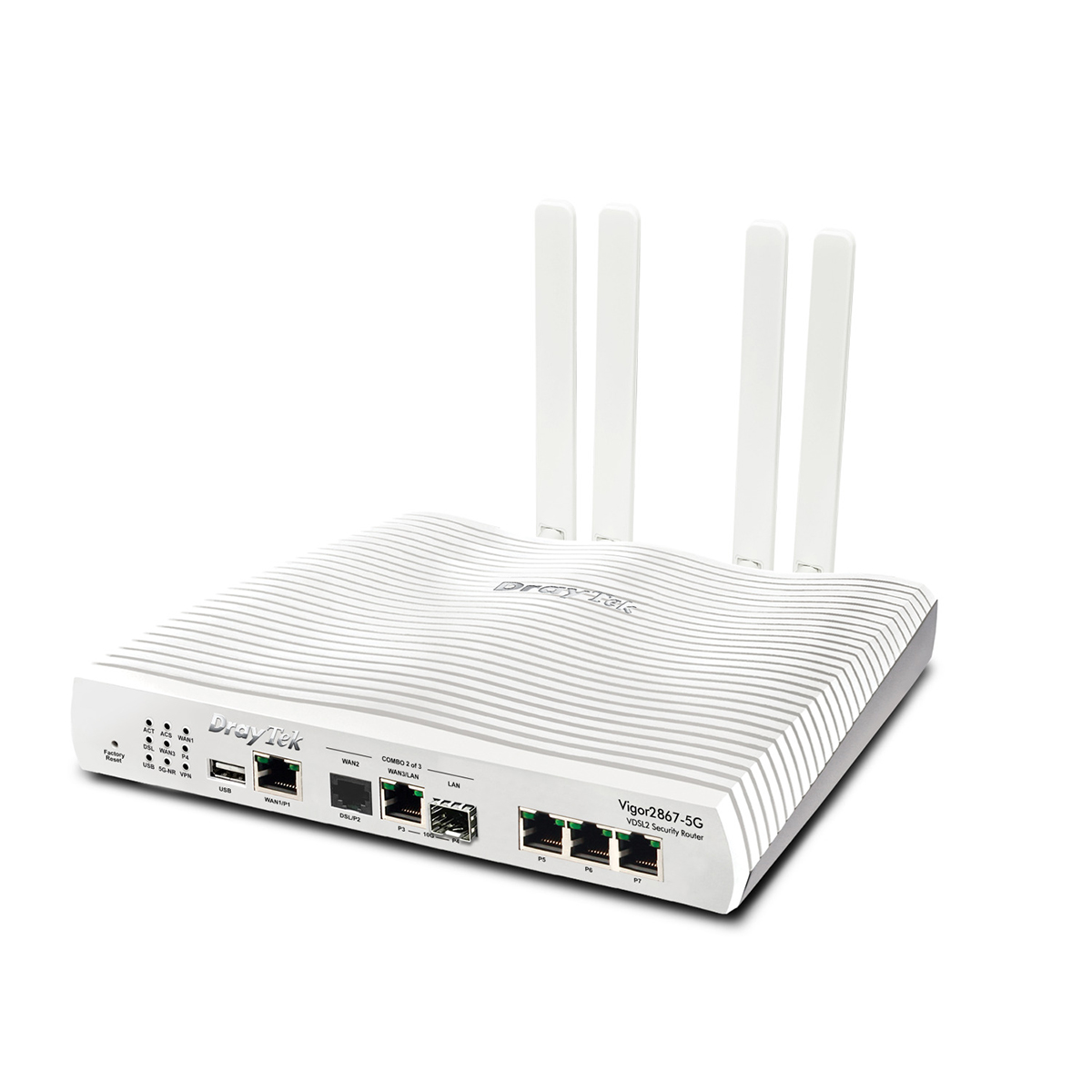
The DrayTek Vigor V2867-5G-K Multi-Gigabit Multi-WAN VDSL and FTTP Firewall VPN Router combines wired broadband, high-speed Ethernet and integrated 5G connectivity to support flexible internet access for businesses and branch offices. With multi-WAN load balancing, automatic failover, advanced firewall controls and VPN connectivity, it helps maintain network access while giving administrators greater control over traffic and security. Multi-gigabit ports, dual-SIM mobile connectivity and centralised management capabilities make it suitable for organisations requiring alternative internet connections and secure communication between multiple locations.
Key Features of DrayTek V2867-5G-K
Multi-WAN xDSL and Ethernet FTTP Router with Failover and Load Balancing
5G / 4G with Dual-SIM slots and eSIM support
10 Gigabit Ethernet Port for future-proof connectivity
Up to 9.1Gbps Total Maximum Throughput
Up to 540Mbps IPsec VPN Throughput
50 LAN-to-LAN & Remote Teleworker VPN Tunnels
Switchable 10GbE/SFP+ and dedicated 3x GbE RJ-45 LAN Ports
QoS and VLAN support for traffic prioritisation and network segmentation
SPI Firewall and Content Filtering
High-Performance VPN
Supports up to 50 VPN tunnels with 540Mbps IPsec throughput. Ideal for secure remote access and connecting multiple offices seamlessly.
Benefits: Secure remote access. Scalable for multiple users.
Always-On Cellular Connectivity
Integrated cellular modem with SIM and eSIM support enables flexible Internet access wherever your business operates. Automatic failover keeps you connected if the primary connection is unavailable.
Benefits: Rapid deployment. Primary and failover WAN connectivity.
Multi-WAN VDSL & FTTP 10Gb Router
Multi-WAN VDSL & FTTP 10Gb Router
Benefits: Compatible with many ISPs and line types, including xDSL. Flexible for business or high-performance networks.
Multi-Gigabit LAN Connectivity with VLAN Support
Connect computers, servers, NAS, and high-speed devices directly with multiple LAN ports. Use VLANs to create separate networks for broadband, VPN, or guest access.
Benefits: Optimise traffic for different users. Flexible mix of physical and vitual networks.
Advanced Firewall & Content Filtering
Integrated SPI firewall, DoS protection, and content filters keep your network safe while controlling access and blocking unwanted content.
Benefits: Enhanced network security. Flexible contentt management.
Flexible Standalone or Centralised Management
Operate the router independently or manage multiple devices via VigorACS for streamlined monitoring and control.
Benefits: Easy management. Scalable for growing networks.
The Ideal xDSL and FTTP Gateway for Fast, Secure Business Networks
A high-speed xDSL and FTTP business router with integrated firewall, 10GbE connectivity, and a built-in VDSL modem, designed for demanding fibre and broadband environments. It delivers powerful routing performance, dependable WAN failover, secure VPN connectivity for remote workers, and flexible multi-gigabit LAN connectivity. An ideal next-generation FTTP and VDSL gateway for SMBs, branch offices, and organisations that need a fast, secure, and flexible network foundation.
High-Speed 5G/4G Connectivity
The integrated 5G modem delivers ultra-fast Internet access over both 5G and 4G LTE networks, enabling high-performance connectivity without reliance on fixed-line infrastructure. With support for both traditional SIM cards and eSIM technology, organisations can simplify deployment and choose the connectivity option that best suits their requirements. Whether operating as the primary WAN connection or as a failover link for fibre and broadband services, it provides the speed, flexibility, and resilience needed for modern business networks.
I/O Diagram
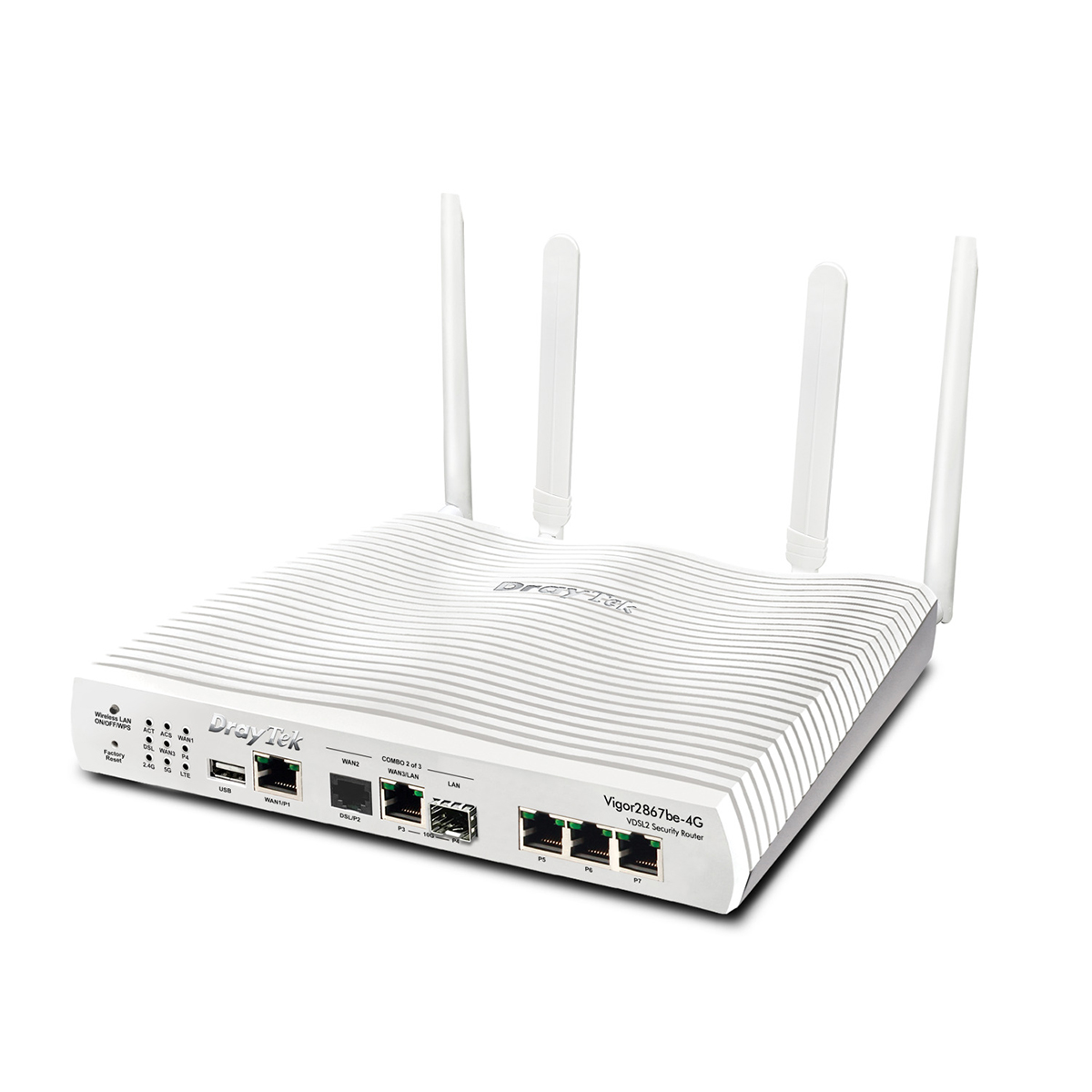
The DrayTek Vigor V2867BE-4G-K Multi-WAN VPN router combines VDSL and ADSL broadband, Ethernet fibre connectivity and built-in 4G LTE mobile access in one unit. With Wi-Fi 7 wireless networking, 10GbE and 10G SFP+ interfaces, it supports high-speed data transfers and flexible internet access for offices and branch locations. Dual Nano SIM slots and eSIM support provide mobile network options, while load balancing, automatic WAN failover, VPN connectivity and firewall controls help administrators manage network availability and security.
Key Features of DrayTek V2867BE-4G-K
Multi-WAN xDSL and Ethernet FTTP Router with Failover and Load Balancing
4G / LTE with Dual-SIM slots and eSIM support
10 Gigabit Ethernet Port for future-proof connectivity
Up to 9.1Gbps Total Maximum Throughput
Up to 540Mbps IPsec VPN Throughput
50 LAN-to-LAN & Remote Teleworker VPN Tunnels
Switchable 10GbE/SFP+ and dedicated 3x GbE RJ-45 LAN Ports
QoS and VLAN support for traffic prioritisation and network segmentation
SPI Firewall and Content Filtering
High-Performance VPN
Supports up to 50 VPN tunnels with 540Mbps IPsec throughput. Ideal for secure remote access and connecting multiple offices seamlessly.
Benefits: Secure remote access. Scalable for multiple users.
Always-On Cellular Connectivity
Integrated cellular modem with SIM and eSIM support enables flexible Internet access wherever your business operates. Automatic failover keeps you connected if the primary connection is unavailable.
Benefits: Rapid deployment. Primary and failover WAN connectivity.
Multi-WAN VDSL & FTTP 10Gb Router
Fully compatible FTTP router with a 10Gb-ready interface and built-in xDSL modem. Delivers up to 9.1Gbps with firewall, content filtering, and QoS for secure, high-performance networking.
Benefits: Compatible with many ISPs and line types, including xDSL. Flexible for business or high-performance networks.
Multi-Gigabit LAN Connectivity with VLAN Support
Connect computers, servers, NAS, and high-speed devices directly with multiple LAN ports. Use VLANs to create separate networks for broadband, VPN, or guest access.
Benefits: Optimise traffic for different users. Flexible mix of physical and virtual networks.
BE7200 Wi-Fi 7 Performance
High-performance BE7200 Wi-Fi 7 with Multi-Link Operation (MLO), OFDMA and 4K-QAM for faster speeds, lower latency and greater wireless efficiency.
Benefits: Support more devices with smoother streaming, faster downloads, and reliable wireless performance.
Flexible Standalone or Centralised Management
Operate the router independently or manage multiple devices via VigorACS for streamlined monitoring and control.
Benefits: Esy management. Scalable for growing networks.
The Ideal xDSL and FTTP Gateway for Fast, Secure Business Networks
A high-speed xDSL and FTTP business router with integrated firewall, 10GbE connectivity, and a built-in VDSL modem, designed for demanding fibre and broadband environments. It delivers powerful routing performance, dependable WAN failover, secure VPN connectivity for remote workers, and flexible multi-gigabit LAN connectivity. An ideal next-generation FTTP and VDSL gateway for SMBs, branch offices, and organisations that need a fast, secure, and flexible network foundation.
Flexible 4G/LTE Broadband Connectivity
The integrated 4G/LTE modem provides flexible Internet connectivity for locations where fixed-line broadband is unavailable, impractical, or still being deployed. Supporting both traditional SIM cards and eSIM technology, it enables rapid deployment and greater service provider flexibility. Whether used as the primary WAN connection or as a backup for fibre and broadband services, automatic failover ensures your business stays connected when it matters most.
Advanced Wi?Fi 7 Wireless Networking
The Vigor 2867be models deliver next-generation Wi?Fi 7 (802.11be) connectivity, providing faster speeds, lower latency, and improved wireless efficiency. It supports advanced Wi?Fi 7 technologies such as Multi-Link Operation (MLO) for enhanced reliability and reduced latency, 4K-QAM for increased throughput, and MU-MIMO/OFDMA to optimise performance in busy wireless environments. These capabilities make the Vigor 2867be ideal for cloud applications, video conferencing, hybrid working, and high-speed file transfers, while maintaining stable and responsive connections for multiple devices at the same time.
I/O Diagram
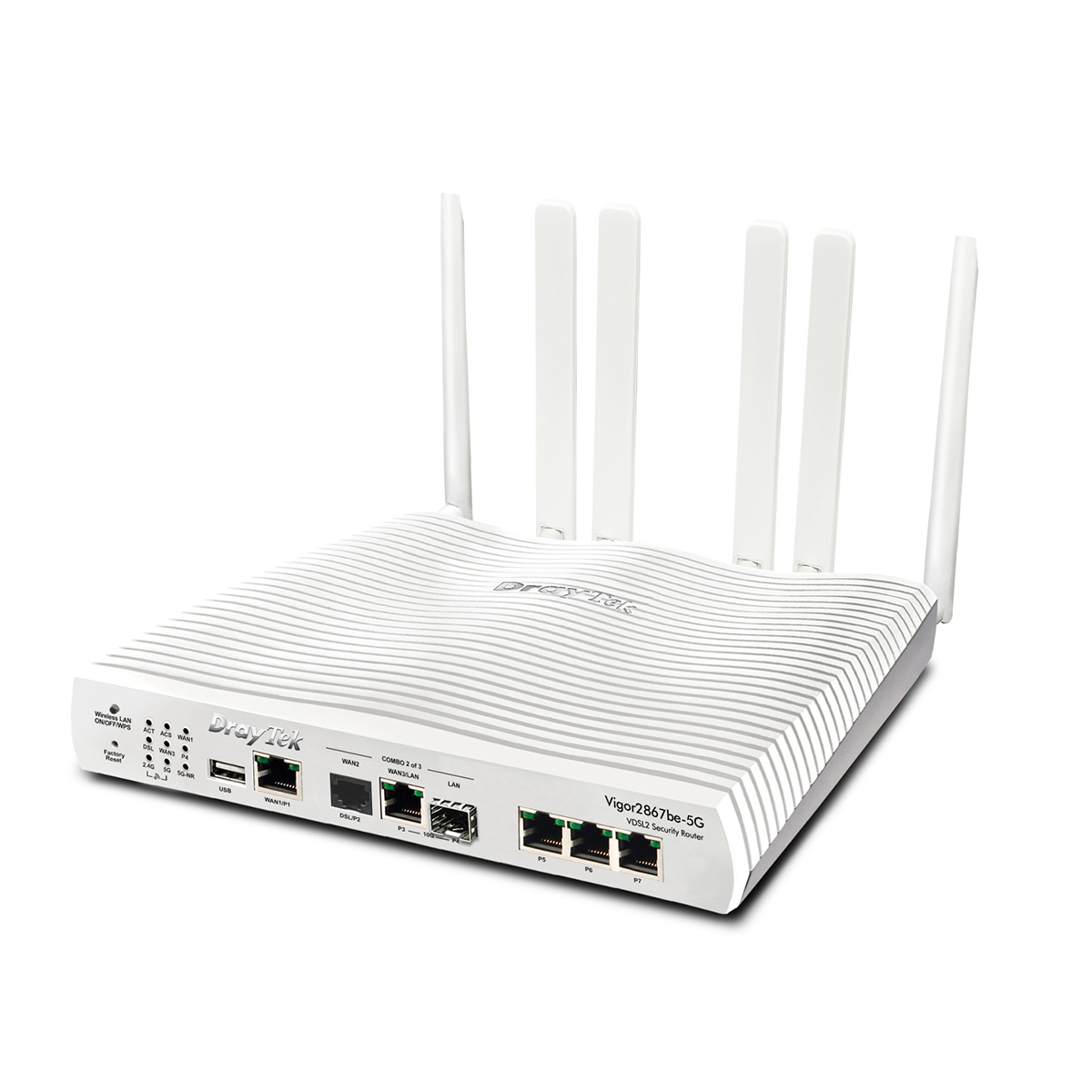
The DrayTek Vigor V2867BE-5G-K Multi-WAN VPN router combines 5G mobile broadband, VDSL connectivity, Ethernet fibre access and Wi-Fi 7 wireless networking in one device. With 10GbE connectivity, a 10G SFP+ interface, dual Nano SIM slots and embedded eSIM support, it offers flexible options for primary internet access and backup connectivity. Load balancing, automatic WAN failover, VPN tunnels and integrated firewall controls help businesses manage network traffic, connect remote users and maintain access to essential online services.
Key Features of DrayTek V2867BE-5G-K
Multi-WAN xDSL and Ethernet FTTP Router with Failover and Load Balancing
5G / 4G with Dual-SIM slots and eSIM support
10 Gigabit Ethernet Port for future-proof connectivity
Up to 9.1Gbps Total Maximum Throughput
Up to 540Mbps IPsec VPN Throughput
50 LAN-to-LAN & Remote Teleworker VPN Tunnels
Switchable 10GbE/SFP+ and dedicated 3x GbE RJ-45 LAN Ports
QoS and VLAN support for traffic prioritisation and network segmentation
BE7200 Dual-Band Wi-Fi 7 with Multi-Link Operation (MLO)
SPI Firewall and Content Filtering
High-Performance VPN
Supports up to 50 VPN tunnels with 540Mbps IPsec throughput. Ideal for secure remote access and connecting multiple offices seamlessly.
Benefits: Secure remote access. Scalable for multiple users.
Always-On Cellular Connectivity
Integrated cellular modem with SIM and eSIM support enables flexible Internet access wherever your business operates. Automatic failover keeps you connected if the primary connection is unavailable.
Benefits: Raid deployment. Primary and failover WAN connectivity.
Multi-WAN VDSL & FTTP 10Gb Router
Fully compatible FTTP router with a 10Gb-ready interface and built-in xDSL modem. Delivers up to 9.1Gbps with firewall, content filtering, and QoS for secure, high-performance networking.
Benefits: Compatible with many ISPs and line types, including xDSL. Flexible for business or high-performance networks.
Multi-Gigabit LAN Connectivity with VLAN Support
Connect computers, servers, NAS, and high-speed devices directly with multiple LAN ports. Use VLANs to create separate networks for broadband, VPN, or guest access.
Benefits:Optimise traffic for different users. Flexible mix of physical and virtual networks.
BE7200 Wi-Fi 7 Performance
High-performance BE7200 Wi-Fi 7 with Multi-Link Operation (MLO), OFDMA and 4K-QAM for faster speeds, lower latency and greater wireless efficiency.
Benefits: Support more devices with smoother streaming, faster downloads, and reliable wireless performance.
Flexible Standalone or Centralised Management
Operate the router independently or manage multiple devices via VigorACS for streamlined monitoring and control.
Benefits: Easy management. Scalable for growing networks.
The Ideal xDSL and FTTP Gateway for Fast, Secure Business Networks
A high-speed xDSL and FTTP business router with integrated firewall, 10GbE connectivity, and a built-in VDSL modem, designed for demanding fibre and broadband environments. It delivers powerful routing performance, dependable WAN failover, secure VPN connectivity for remote workers, and flexible multi-gigabit LAN connectivity. An ideal next-generation FTTP and VDSL gateway for SMBs, branch offices, and organisations that need a fast, secure, and flexible network foundation.
High-Speed 5G/4G Connectivity
The integrated 5G modem delivers ultra-fast Internet access over both 5G and 4G LTE networks, enabling high-performance connectivity without reliance on fixed-line infrastructure. With support for both traditional SIM cards and eSIM technology, organisations can simplify deployment and choose the connectivity option that best suits their requirements. Whether operating as the primary WAN connection or as a failover link for fibre and broadband services, it provides the speed, flexibility, and resilience needed for modern business networks.
Advanced Wi?Fi 7 Wireless Networking
The Vigor 2867be models deliver next-generation Wi?Fi 7 (802.11be) connectivity, providing faster speeds, lower latency, and improved wireless efficiency. It supports advanced Wi?Fi 7 technologies such as Multi-Link Operation (MLO) for enhanced reliability and reduced latency, 4K-QAM for increased throughput, and MU-MIMO/OFDMA to optimise performance in busy wireless environments. These capabilities make the Vigor 2867be ideal for cloud applications, video conferencing, hybrid working, and high-speed file transfers, while maintaining stable and responsive connections for multiple devices at the same time.
I/O Diagram
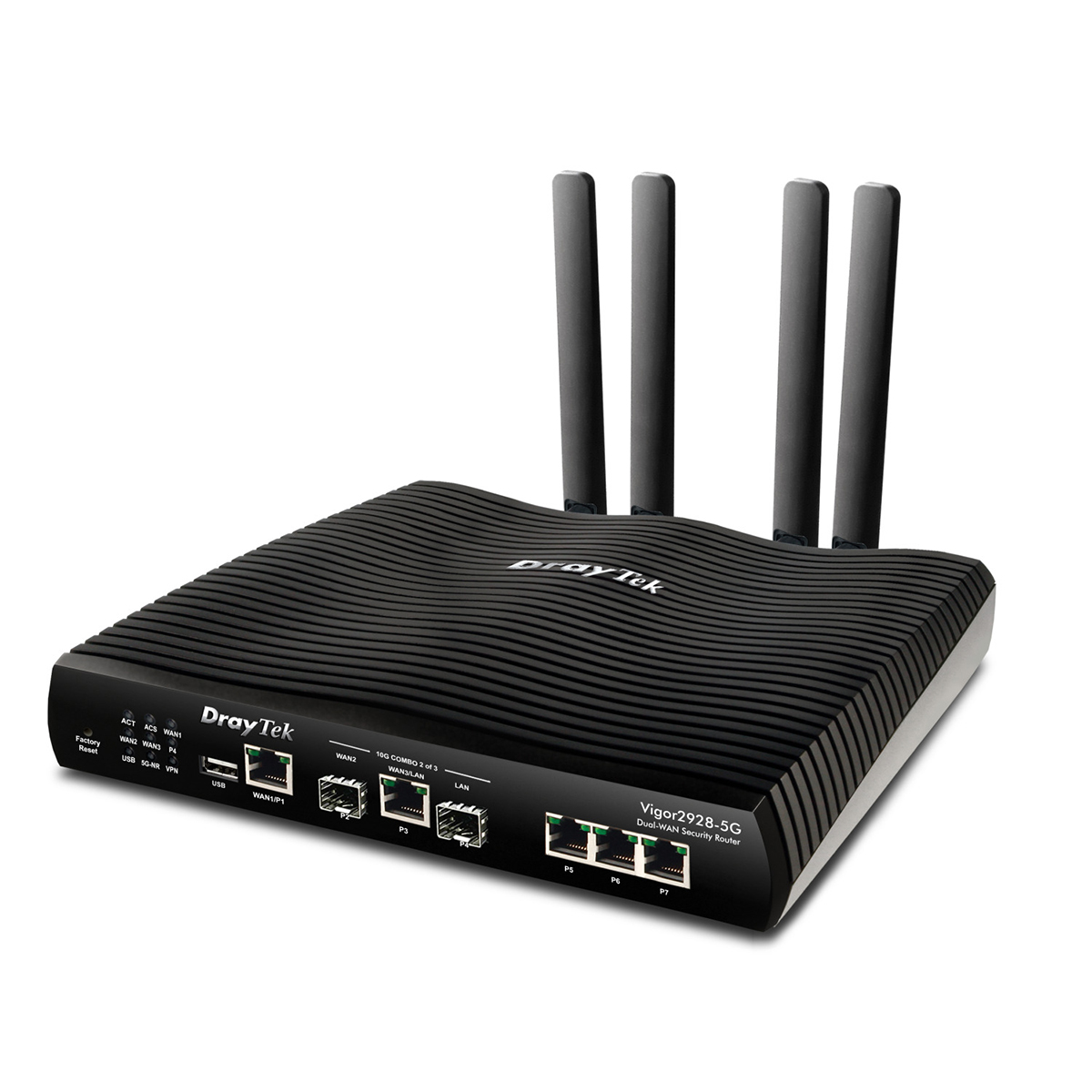
The DrayTek Vigor V2928-5G-K Multi-WAN fibre router combines high-speed Ethernet connectivity with integrated 5G and 4G LTE mobile broadband for flexible internet access. Featuring 10 Gigabit Ethernet and SFP+ interfaces, multiple WAN connections and mobile network support, it accommodates fibre broadband deployments that require additional connectivity options. Load balancing, automatic WAN failover, VPN functionality and integrated firewall controls help administrators manage traffic, connect remote users and protect network resources across business locations.
Key Features of DrayTek V2928-5G-K
Multi-WAN Ethernet and SFP+ FTTP Router with Failover and Load Balancing
5G/4G LTE with Dual-SIM slots and eSIM support
10 Gigabit Ethernet Port for future-proof connectivity
Up to 9.3Gbps Total Maximum Throughput
Up to 540Mbps IPsec VPN Throughput
50 LAN-to-LAN & Remote Teleworker VPN Tunnels
Switchable 10GbE/SFP+ and dedicated 3x GbE RJ-45 LAN Ports
QoS and VLAN support for traffic prioritisation and network segmentation
BE7200 Dual-Band Wi-Fi 7 with Multi-Link Operation (MLO)
SPI Firewall and Content Filtering
Multi-WAN FTTP 10Gb Router
Fully compatible Fibre FTTP router with future-ready 10Gb interface. Delivers up to 9.3Gbps throughput with integrated Firewall, Content Filtering and Quality of Service for secure, optimised network performance.
Benefits: Compatible with a wide range of ISPs. Flexible deployment for business or high-performance networks.
Always-On Cellular Connectivity
Integrated cellular modem with SIM and eSIM support enables flexible Internet access wherever your business operates. Automatic failover keeps you connected if the primary connection is unavailable.
Benefits: Rapid deployment. Primary and failover WAN connectivity.
High-Performance VPN
Supports up to 50 VPN tunnels with 540Mbps IPsec throughput. Ideal for secure remote access and connecting multiple offices seamlessly.
Benefits: Secure remote access. Scalable for multiple users.
Multi-Gigabit LAN Connectivity with VLAN Support
Connect computers, servers, NAS, and high-speed devices directly with multiple LAN ports. Use VLANs to create separate networks for broadband, VPN, or guest access.
Benefits: Optimize traffic for different users. Flexible mix of physical and virtual networks.
Advanced Firewall & Content Filtering
Integrated SPI firewall, DoS protection, and content filters keep your network safe while controlling access and blocking unwanted content.
Benefits: Enhanced network security. Flexible content management.
Flexible Standalone or Centralised Management
Operate the router independently or manage multiple devices via VigorACS for streamlined monitoring and control.
Benefits: Easy management. Scalable for growing networks.
The Ideal FTTP Gateway for Fast, Secure Business Networks
A high-speed FTTP business router with integrated firewall, 10GbE connectivity, and multi-gigabit WAN and LAN interfaces, designed for demanding fibre environments. It delivers powerful routing performance, dependable WAN failover, secure VPN connectivity for remote workers, and flexible multi-gigabit LAN connectivity. An ideal next-generation FTTP gateway for SMBs, branch offices, and organisations that need a fast, secure, and flexible network foundation.
Future-Proof Multi-Gigabit Networking
Engineered for ambitious SMB environments, the Vigor 2928 delivers up to 9.3Gbps throughput to support bandwidth-intensive applications, cloud services, video collaboration, and growing multi-gigabit Internet connections. With integrated 10GbE and SFP+ interfaces that can be configured for WAN connectivity, it provides the flexibility to maximise fibre broadband performance while supporting future network expansion. Advanced routing, Quality of Service (QoS), content filtering, and comprehensive VPN capabilities help ensure reliable connectivity, secure remote access, and efficient traffic management across the business.
Flexible 4G/LTE Broadband Connectivity
The integrated 4G/LTE modem provides flexible Internet connectivity for locations where fixed-line broadband is unavailable, impractical, or still being deployed. Supporting both traditional SIM cards and eSIM technology, it enables rapid deployment and greater service provider flexibility. Whether used as the primary WAN connection or as a backup for fibre and broadband services, automatic failover ensures your business stays connected when it matters most.
I/O Diagram
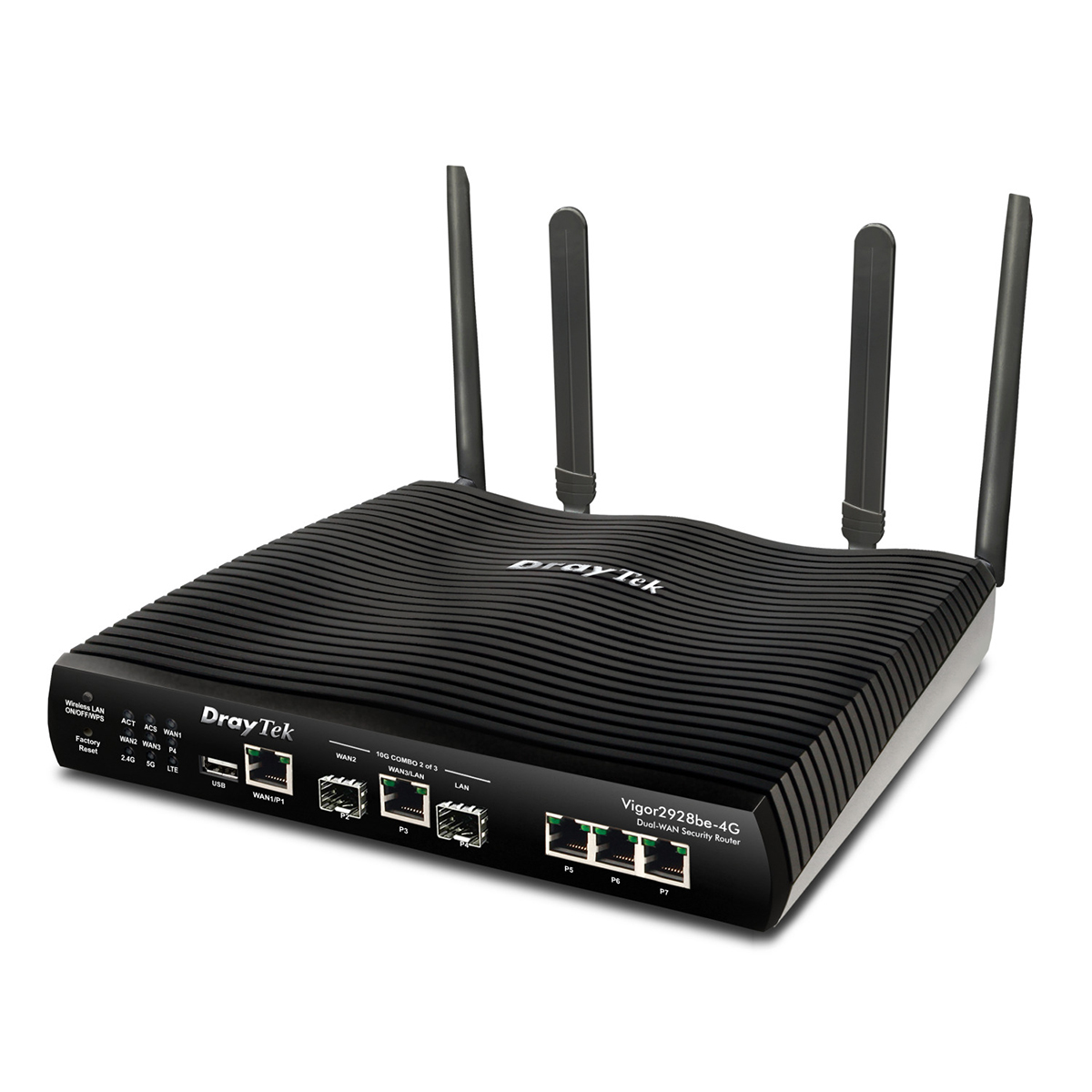
The DrayTek Vigor V2928BE-4G-K Multi-Gigabit Multi-WAN Fibre Firewall VPN Router combines high-speed Ethernet and fibre connectivity with integrated 4G LTE mobile broadband and Wi-Fi 7 wireless networking. With 10GbE and SFP+ interfaces, dual Nano SIM slots and embedded eSIM support, it provides flexible options for internet access and backup connectivity. Multi-WAN load balancing, automatic failover, VPN tunnels and integrated firewall controls help businesses manage network traffic, connect remote users and maintain secure access to network resources.
Key Features of DrayTek V2928BE-4G-K
Multi-WAN Ethernet and SFP+ FTTP Router with Failover and Load Balancing
4G / LTE with Dual-SIM slots and eSIM support
10 Gigabit Ethernet Port for future-proof connectivity
Up to 9.3Gbps Total Maximum Throughput
Up to 540Mbps IPsec VPN Throughput
50 LAN-to-LAN & Remote Teleworker VPN Tunnels
Switchable 10GbE/SFP+ and dedicated 3x GbE RJ-45 LAN Ports
QoS and VLAN support for traffic prioritisation and network segmentation
BE7200 Dual-Band Wi-Fi 7 with Multi-Link Operation (MLO)
SPI Firewall and Content Filtering
Multi-WAN FTTP 10Gb Router
Fully compatible Fibre FTTP router with future-ready 10Gb interface. Delivers up to 9.3Gbps throughput with integrated Firewall, Content Filtering and Quality of Service for secure, optimised network performance.
Benefits: Compatible with a wide range of ISPs. Flexible deployment for business or high-performance networks.
Always-On Cellular Connectivity
Integrated cellular modem with SIM and eSIM support enables flexible Internet access wherever your business operates. Automatic failover keeps you connected if the primary connection is unavailable.
Benefits: Rapid deployment. Primary and failover WAN connectivity.
High-Performance VPN
Supports up to 50 VPN tunnels with 540Mbps IPsec throughput. Ideal for secure remote access and connecting multiple offices seamlessly.
Benefits: Secure remote access. Scalable for multiple users.
Multi-Gigabit LAN Connectivity with VLAN Support
Connect computers, servers, NAS, and high-speed devices directly with multiple LAN ports. Use VLANs to create separate networks for broadband, VPN, or guest access.
Benefits: Optimize traffic for different users. Flexible mix of physical and virtual networks.
BE7200 Wi-Fi 7 Performance
High-performance BE7200 Wi-Fi 7 with Multi-Link Operation (MLO), OFDMA and 4K-QAM for faster speeds, lower latency and greater wireless efficiency.
Benefits: Support more devices with smoother streaming, faster downloads, and reliable wireless performance.
Flexible Standalone or Centralised Management
Operate the router independently or manage multiple devices via VigorACS for streamlined monitoring and control.
Benefits: Easy management. Scalable for growing networks.
The Ideal FTTP Gateway for Fast, Secure Business Networks
A high-speed FTTP business router with integrated firewall, 10GbE connectivity, and multi-gigabit WAN and LAN interfaces, designed for demanding fibre-based environments. It delivers powerful routing performance, dependable WAN failover, secure VPN connectivity for remote workers, and flexible high-performance networking. An ideal next-generation FTTP gateway for SMBs, branch offices, and organisations that need a fast, secure, and flexible network foundation.
Future-Proof Multi-Gigabit Networking
Engineered for ambitious SMB environments, the Vigor 2928 delivers up to 9.3Gbps throughput to support bandwidth-intensive applications, cloud services, video collaboration, and growing multi-gigabit Internet connections. With integrated 10GbE and SFP+ interfaces that can be configured for WAN connectivity, it provides the flexibility to maximise fibre broadband performance while supporting future network expansion. Advanced routing, Quality of Service (QoS), content filtering, and comprehensive VPN capabilities help ensure reliable connectivity, secure remote access, and efficient traffic management across the business.
Flexible 4G/LTE Broadband Connectivity
The integrated 4G/LTE modem provides flexible Internet connectivity for locations where fixed-line broadband is unavailable, impractical, or still being deployed. Supporting both traditional SIM cards and eSIM technology, it enables rapid deployment and greater service provider flexibility. Whether used as the primary WAN connection or as a backup for fibre and broadband services, automatic failover ensures your business stays connected when it matters most.
Advanced Wi-Fi 7 Wireless Networking
The Vigor 2928be models deliver next-generation Wi-Fi 7 (802.11be) connectivity, providing faster speeds, lower latency, and improved wireless efficiency. It supports advanced Wi-Fi 7 technologies such as Multi-Link Operation (MLO) for enhanced reliability and reduced latency, 4K-QAM for increased throughput, and MU-MIMO/OFDMA to optimise performance in busy wireless environments. These capabilities make the Vigor 2867be ideal for cloud applications, video conferencing, hybrid working, and high-speed file transfers, while maintaining stable and responsive connections for multiple devices at the same time.
I/O Diagram
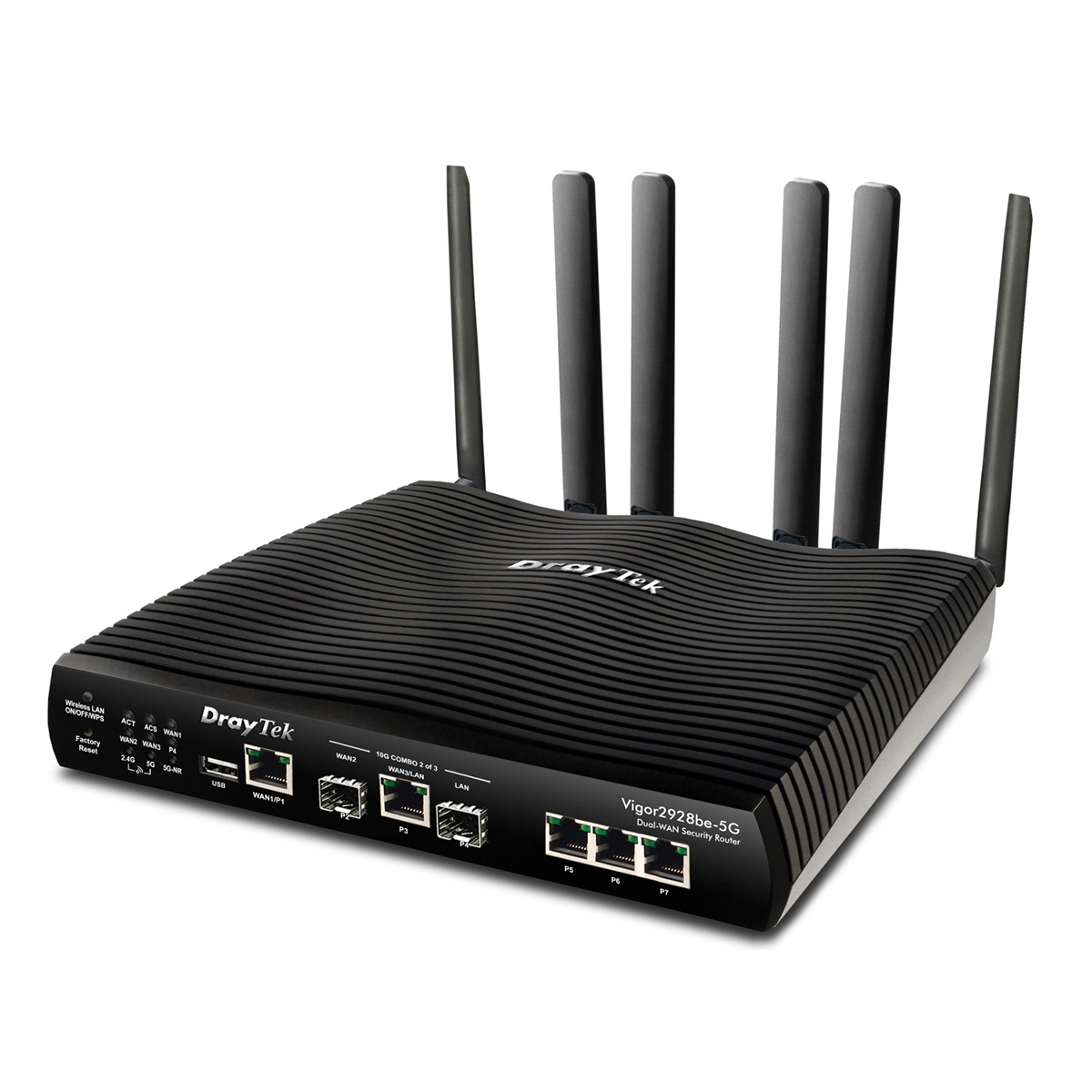
The DrayTek Vigor V2928BE-5G-K Multi-Gigabit Multi-WAN Fibre Firewall VPN Router combines high-speed fibre networking, integrated 5G mobile broadband and Wi-Fi 7 wireless connectivity in one device. With 10GbE and SFP+ interfaces, dual Nano SIM slots and embedded eSIM support, it provides flexible options for primary internet access and backup connectivity. Multi-WAN load balancing, automatic failover, VPN access and integrated firewall controls help businesses manage traffic, connect remote users and protect network resources across multiple locations.
Key Features of DrayTek V2928BE-5G-K
Multi-WAN Ethernet and SFP+ FTTP Router with Failover and Load Balancing
5G/4G LTE with Dual-SIM slots and eSIM support
10 Gigabit Ethernet Port for future-proof connectivity
Up to 9.3Gbps Total Maximum Throughput
Up to 540Mbps IPsec VPN Throughput
50 LAN-to-LAN & Remote Teleworker VPN Tunnels
Switchable 10GbE/SFP+ and dedicated 3x GbE RJ-45 LAN Ports
QoS and VLAN support for traffic prioritisation and network segmentation
BE7200 Dual-Band Wi-Fi 7 with Multi-Link Operation (MLO)
SPI Firewall and Content Filtering
Multi-WAN FTTP 10Gb Router
Fully compatible Fibre FTTP router with future-ready 10Gb interface. Delivers up to 9.3Gbps throughput with integrated Firewall, Content Filtering and Quality of Service for secure, optimised network performance.
Benefits: Compatible with a wide range of ISPs. Flexible deployment for business or high-performance networks.
Always-On Cellular Connectivity
Integrated cellular modem with SIM and eSIM support enables flexible Internet access wherever your business operates. Automatic failover keeps you connected if the primary connection is unavailable.
Benefits: Rapid deployment. Primary and failover WAN connectivity.
High-Performance VPN
Supports up to 50 VPN tunnels with 540Mbps IPsec throughput. Ideal for secure remote access and connecting multiple offices seamlessly.
Benefits: Secure remote access. Scalable for multiple users.
Multi-Gigabit LAN Connectivity with VLAN Support
Connect computers, servers, NAS, and high-speed devices directly with multiple LAN ports. Use VLANs to create separate networks for broadband, VPN, or guest access.
Benefits: Optimize traffic for different users. Flexible mix of physical and virtual networks.
BE7200 Wi-Fi 7 Performance
High-performance BE7200 Wi-Fi 7 with Multi-Link Operation (MLO), OFDMA and 4K-QAM for faster speeds, lower latency and greater wireless efficiency.
Benefits: Support more devices with smoother streaming, faster downloads, and reliable wireless performance.
Flexible Standalone or Centralised Management
Operate the router independently or manage multiple devices via VigorACS for streamlined monitoring and control.
Benefits: Easy management. Scalable for growing networks.
The Ideal FTTP Gateway for Fast, Secure Business Networks
A high-speed FTTP business router with integrated firewall, 10GbE connectivity, and multi-gigabit WAN and LAN interfaces, designed for demanding fibre-based environments. It delivers powerful routing performance, dependable WAN failover, secure VPN connectivity for remote workers, and flexible high-performance networking. An ideal next-generation FTTP gateway for SMBs, branch offices, and organisations that need a fast, secure, and flexible network foundation.
Future-Proof Multi-Gigabit Networking
Engineered for ambitious SMB environments, the Vigor 2928 delivers up to 9.3Gbps throughput to support bandwidth-intensive applications, cloud services, video collaboration, and growing multi-gigabit Internet connections. With integrated 10GbE and SFP+ interfaces that can be configured for WAN connectivity, it provides the flexibility to maximise fibre broadband performance while supporting future network expansion. Advanced routing, Quality of Service (QoS), content filtering, and comprehensive VPN capabilities help ensure reliable connectivity, secure remote access, and efficient traffic management across the business.
High-Speed 5G/4G Connectivity
The integrated 5G modem delivers ultra-fast Internet access over both 5G and 4G LTE networks, enabling high-performance connectivity without reliance on fixed-line infrastructure. With support for both traditional SIM cards and eSIM technology, organisations can simplify deployment and choose the connectivity option that best suits their requirements. Whether operating as the primary WAN connection or as a failover link for fibre and broadband services, it provides the speed, flexibility, and resilience needed for modern business networks.
Advanced Wi-Fi 7 Wireless Networking
The Vigor 2928be models deliver next-generation Wi-Fi 7 (802.11be) connectivity, providing faster speeds, lower latency, and improved wireless efficiency. It supports advanced Wi-Fi 7 technologies such as Multi-Link Operation (MLO) for enhanced reliability and reduced latency, 4K-QAM for increased throughput, and MU-MIMO/OFDMA to optimise performance in busy wireless environments. These capabilities make the Vigor 2867be ideal for cloud applications, video conferencing, hybrid working, and high-speed file transfers, while maintaining stable and responsive connections for multiple devices at the same time.
I/O Diagram