



| Product Code: | |
| Options: | |
| Qty: | |
| Unit Price: | £ |

| Part No: | FESWM280 |
| Manufacturer No: | SWM280 |
| Delivery: | In Stock: Next Day |



 |
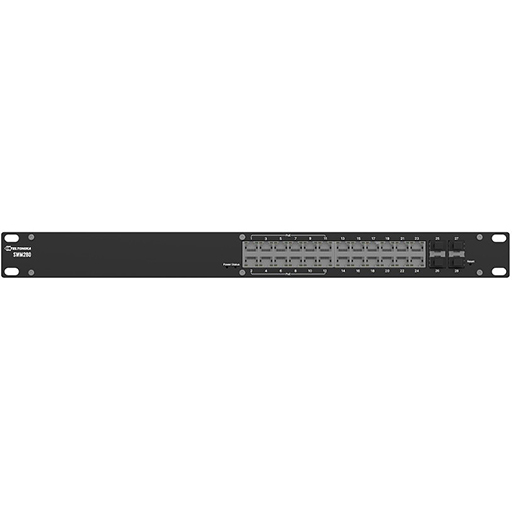
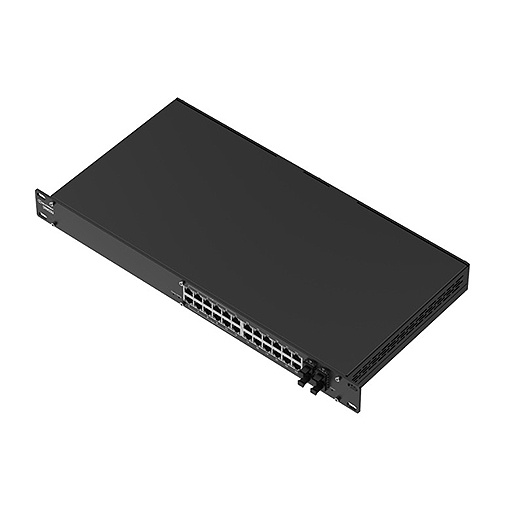
The Teltonika SWM280 is a managed L2+ network switch that combines 24 Gigabit Ethernet ports with 4 SFP interfaces for copper and fibre connectivity. It provides 12 PoE+ ports capable of delivering up to 30 W per port, with a total PoE power budget of 300 W, while its routing, VLAN, QoS and network management features provide extensive control over connected devices and traffic.
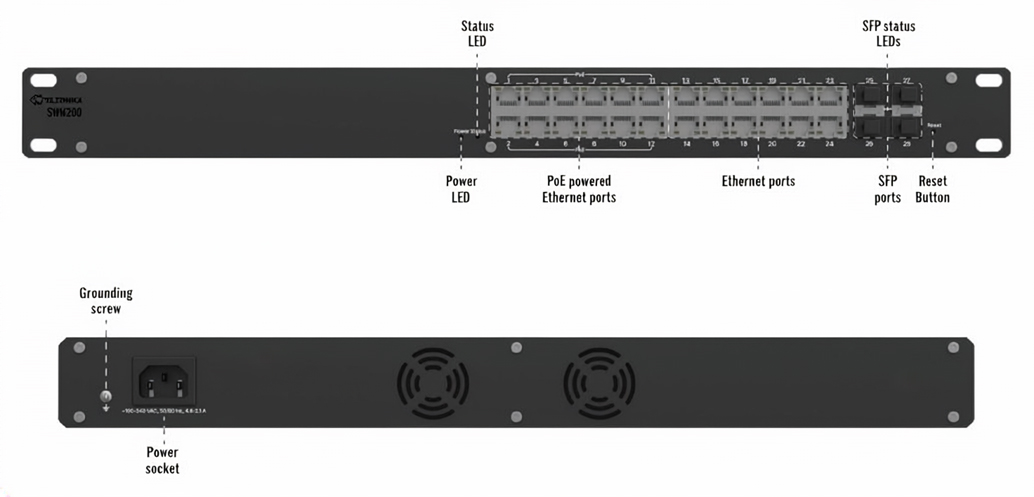
The switch provides 24 managed RJ45 Ethernet ports with 10/100/1000 Mbps operation and auto MDI/MDIX crossover. Four additional SFP ports provide fibre connectivity for network uplinks and longer-distance connections, while support for IEEE 802.3i, 802.3u, 802.3ab, 802.3x, 802.3az and 802.3ad standards allows it to integrate into a range of network environments.
Twelve Ethernet ports support IEEE 802.3af PoE and IEEE 802.3at PoE+ using Alternative A. Each PoE+ port can provide up to 30 W, with a combined PoE power budget of 300 W. PoE management can be configured on individual ports, making it possible to monitor and control power delivery to connected equipment.
The SWM280 provides Layer 2 switching functions together with Layer 3 networking capabilities. Features include VLAN segmentation, STP and RSTP, loop protection, static IPv4 and IPv6 routing, DHCPv6 client support and dynamic routing protocols including BGP, OSPF v2, RIP v1/v2 and EIGRP.
Support for industrial networking protocols makes the switch suitable for applications that require communication between network infrastructure and industrial equipment. The switch supports PROFINET, EtherNet/IP and MRP, with PROFINET Class B conformance available with the applicable order code.
Traffic management features include QoS prioritisation, bandwidth control, rate limiting, storm control, port-based traffic shaping and port mirroring. Network access can be controlled through 802.1X, MAC filtering, VLAN separation and authentication methods including RADIUS and TACACS+.
Network administrators can manage the switch through its WebUI and Teltonika RMS. SNMP v2 and v3, LLDP and Teltonika's Web API provide additional management options, while diagnostic tools include cable diagnostics, ping, traceroute and nslookup. RMS can also be used for firmware and configuration management across multiple devices.
The Teltonika SWM280 is a managed L2+ network switch that combines 24 Gigabit Ethernet ports with 4 SFP interfaces for copper and fibre connectivity. It provides 12 PoE+ ports capable of delivering up to 30 W per port, with a total PoE power budget of 300 W, while its routing, VLAN, QoS and network management features provide extensive control over connected devices and traffic.
The switch provides 24 managed RJ45 Ethernet ports with 10/100/1000 Mbps operation and auto MDI/MDIX crossover. Four additional SFP ports provide fibre connectivity for network uplinks and longer-distance connections, while support for IEEE 802.3i, 802.3u, 802.3ab, 802.3x, 802.3az and 802.3ad standards allows it to integrate into a range of network environments.
Twelve Ethernet ports support IEEE 802.3af PoE and IEEE 802.3at PoE+ using Alternative A. Each PoE+ port can provide up to 30 W, with a combined PoE power budget of 300 W. PoE management can be configured on individual ports, making it possible to monitor and control power delivery to connected equipment.
The SWM280 provides Layer 2 switching functions together with Layer 3 networking capabilities. Features include VLAN segmentation, STP and RSTP, loop protection, static IPv4 and IPv6 routing, DHCPv6 client support and dynamic routing protocols including BGP, OSPF v2, RIP v1/v2 and EIGRP.
Support for industrial networking protocols makes the switch suitable for applications that require communication between network infrastructure and industrial equipment. The switch supports PROFINET, EtherNet/IP and MRP, with PROFINET Class B conformance available with the applicable order code.
Traffic management features include QoS prioritisation, bandwidth control, rate limiting, storm control, port-based traffic shaping and port mirroring. Network access can be controlled through 802.1X, MAC filtering, VLAN separation and authentication methods including RADIUS and TACACS+.
Network administrators can manage the switch through its WebUI and Teltonika RMS. SNMP v2 and v3, LLDP and Teltonika's Web API provide additional management options, while diagnostic tools include cable diagnostics, ping, traceroute and nslookup. RMS can also be used for firmware and configuration management across multiple devices.
Product data is provided by Icecat, we do not warrant the accuracy of the material above.