


| Product Code: | |
| Options: | |
| Qty: | |
| Unit Price: | £ |
.jpg "Fluke Networks")
| Part No: | FLLIQ-KIT-FMC |
| Manufacturer No: | LIQ-KIT-FMC |
| Delivery: | In Stock: 5-7 Days |


 |
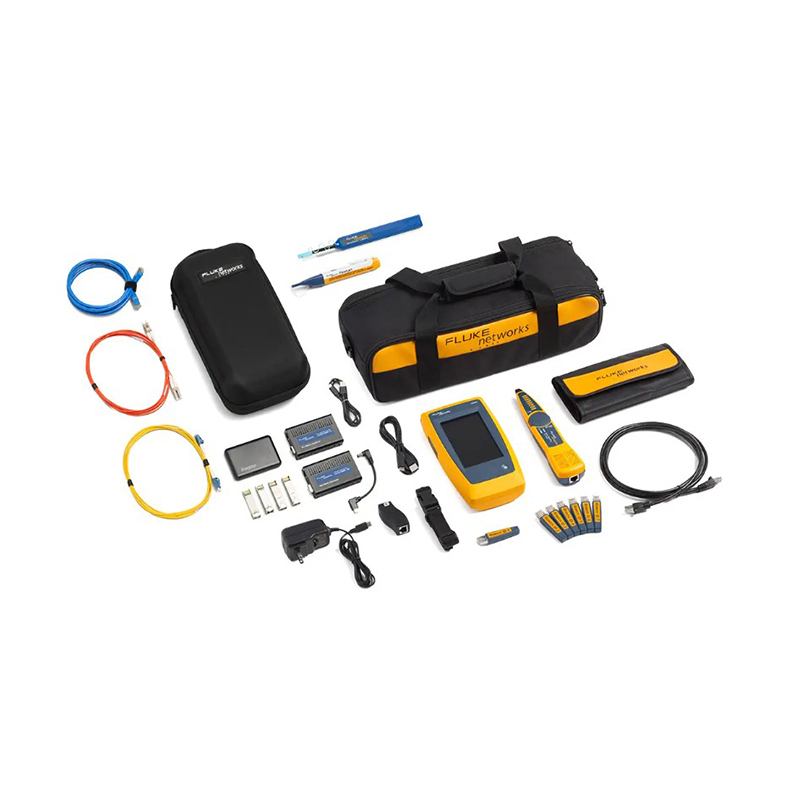
The Fluke LIQ-KIT-FMC is a combined copper and fiber network testing kit designed for field technicians working across mixed infrastructure environments. It brings together LinkIQ cable testing, switch validation, remote identification tools, and a fiber media converter setup to support diagnostics across Ethernet and fiber links in one portable package.
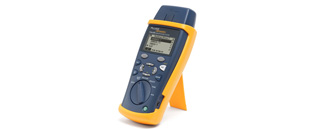
The LinkIQ tester is capable of measuring lengths up to 305 meters (1000 feet) and provides distance to faults such as opens, shorts, and unterminated cable. Using the remote ID allows for a complete wire map of the cable pairs which helps identify miswired and split pairs. The primary cable testing feature of LinkIQ tester is the cable performance test which qualifies the cabling bandwidth from 10BASE-T to 10GBASE-T (10 Mb/s up to 10 Gb/s). It performs these tests via frequency-based measurements. Using IEEE-standardsbased measurements ensures that tested links meet performance requirements as opposed to transmission testers which only prove that the specific test devices can communicate over the link. Operators may set performance requirements from 10 Mb/s to 10 Gb/s for a simple pass/fail indication.
Along with the robust cable testing features, the LinkIQ tester also provides detailed information on the nearest connected switch and connectivity testing with IP ping. The LinkIQ tester negotiates with the switch to identify the advertised data rate (up to 10GBASET), half/full duplex identification, the switch name and IP address, port number, and VLAN info.
Switch port test shows switch name and IP address, connected port, and VLAN (separate screen) along with advertised speed and duplex settings. If a ping test is configured, the target address and average response time are shown. Scroll down to show Power over Ethernet results. The ping test verifies connectivity to devices on the local network or the internet and supports both IPv4 and v6. The address of the LinkIQ tester may be set up manually or through DHCP. Once set, the ping test runs as part of the Autotest when a switch is detected. Results of the ping test include identification and response time of each of four pings to the target, the DNS server, and gateway.
While Power over Ethernet makes installation of devices such as security cameras and access points simpler, a survey by the Ethernet Alliance of over 800 installers, integrators, and end users found that four of five respondents experienced difficulties in integrating PoE systems. Part of this can be traced to the fact that the IEEE offers three PoE standards, the term PoE is not registered, and there are a variety of non-standards-compliant implementations.
To simplify PoE installation and troubleshooting, the LinkIQ tester shows the pairs where power is provided, including the different power levels and pairs for dual-signature implementations. Further, the LinkIQ tester will actually place a load on the connection to ensure that the advertised power is actually being delivered by the switch across the cabling infrastructure. The LinkIQ tester has been certified by the Ethernet Alliance to IEEE802.3™ standards for reliable multivendor interoperability.
The LinkIQ tester provides complete documentation abilities for the tests it performs. Up to 1,000 results can be given descriptive names and stored and recalled in the tester. Test names and numbers automatically increment as each is saved: Annex B-1, Annex B-2, Annex B-3, etc. which saves time when testing cables in sequence. Report data may be exported to a PC for documentation purposes. The LinkIQ tester uses LinkWare™ PC, Fluke Networks’ reporting software which supports a variety of testers going back 20 years and is the industry’s leading reporting solution with tens of thousands of active users. LinkWare PC can be used to store the results as well as generate PDF reports.
This kit supports a wide range of copper diagnostics including cable length measurement, fault detection such as opens or shorts, and identification of wiring issues. It also communicates with network switches to retrieve live configuration data, helping confirm how each port is operating in real time.
With the included fiber media converter module, the kit extends testing into fiber environments using SFP interfaces. This allows technicians to verify connectivity and link status between fiber segments and network switches without requiring separate standalone fiber testers.
The kit is suited for structured cabling environments where both copper and fiber links are present. It is commonly used during installation checks, fault isolation, and routine maintenance across data networks, helping technicians confirm link integrity across multiple media types.
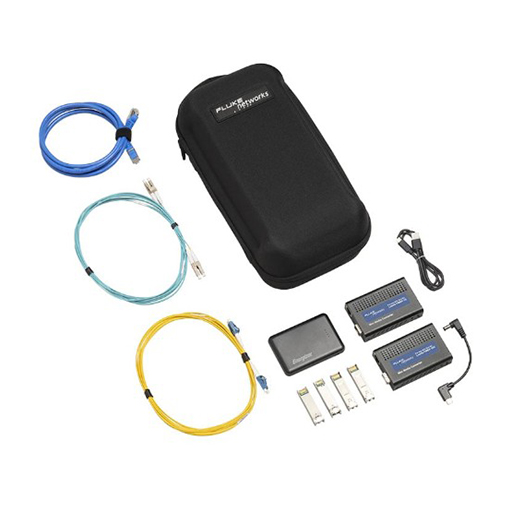
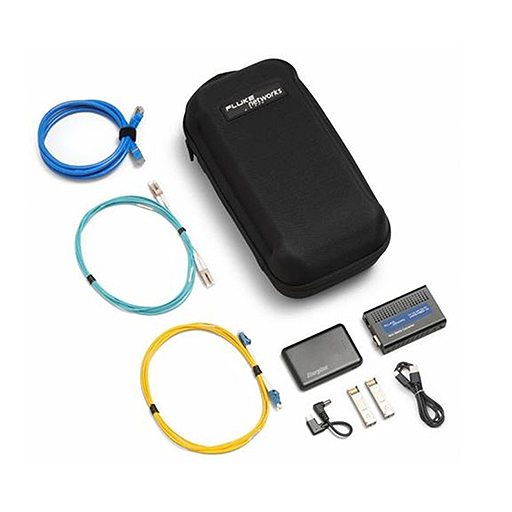
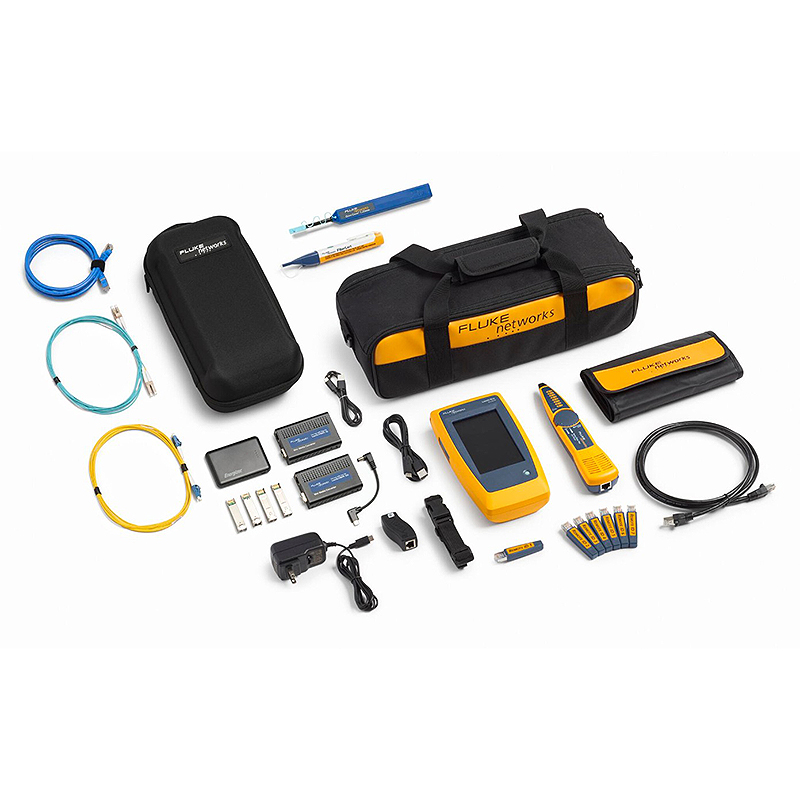
The Fluke LIQ-KIT-FMC includes:
The Fluke LIQ-KIT-FMC is a combined copper and fiber network testing kit designed for field technicians working across mixed infrastructure environments. It brings together LinkIQ cable testing, switch validation, remote identification tools, and a fiber media converter setup to support diagnostics across Ethernet and fiber links in one portable package.
The LinkIQ tester is capable of measuring lengths up to 305 meters (1000 feet) and provides distance to faults such as opens, shorts, and unterminated cable. Using the remote ID allows for a complete wire map of the cable pairs which helps identify miswired and split pairs. The primary cable testing feature of LinkIQ tester is the cable performance test which qualifies the cabling bandwidth from 10BASE-T to 10GBASE-T (10 Mb/s up to 10 Gb/s). It performs these tests via frequency-based measurements. Using IEEE-standardsbased measurements ensures that tested links meet performance requirements as opposed to transmission testers which only prove that the specific test devices can communicate over the link. Operators may set performance requirements from 10 Mb/s to 10 Gb/s for a simple pass/fail indication.
Along with the robust cable testing features, the LinkIQ tester also provides detailed information on the nearest connected switch and connectivity testing with IP ping. The LinkIQ tester negotiates with the switch to identify the advertised data rate (up to 10GBASET), half/full duplex identification, the switch name and IP address, port number, and VLAN info.
Switch port test shows switch name and IP address, connected port, and VLAN (separate screen) along with advertised speed and duplex settings. If a ping test is configured, the target address and average response time are shown. Scroll down to show Power over Ethernet results. The ping test verifies connectivity to devices on the local network or the internet and supports both IPv4 and v6. The address of the LinkIQ tester may be set up manually or through DHCP. Once set, the ping test runs as part of the Autotest when a switch is detected. Results of the ping test include identification and response time of each of four pings to the target, the DNS server, and gateway.
While Power over Ethernet makes installation of devices such as security cameras and access points simpler, a survey by the Ethernet Alliance of over 800 installers, integrators, and end users found that four of five respondents experienced difficulties in integrating PoE systems. Part of this can be traced to the fact that the IEEE offers three PoE standards, the term PoE is not registered, and there are a variety of non-standards-compliant implementations.
To simplify PoE installation and troubleshooting, the LinkIQ tester shows the pairs where power is provided, including the different power levels and pairs for dual-signature implementations. Further, the LinkIQ tester will actually place a load on the connection to ensure that the advertised power is actually being delivered by the switch across the cabling infrastructure. The LinkIQ tester has been certified by the Ethernet Alliance to IEEE802.3™ standards for reliable multivendor interoperability.
The LinkIQ tester provides complete documentation abilities for the tests it performs. Up to 1,000 results can be given descriptive names and stored and recalled in the tester. Test names and numbers automatically increment as each is saved: Annex B-1, Annex B-2, Annex B-3, etc. which saves time when testing cables in sequence. Report data may be exported to a PC for documentation purposes. The LinkIQ tester uses LinkWare™ PC, Fluke Networks’ reporting software which supports a variety of testers going back 20 years and is the industry’s leading reporting solution with tens of thousands of active users. LinkWare PC can be used to store the results as well as generate PDF reports.
This kit supports a wide range of copper diagnostics including cable length measurement, fault detection such as opens or shorts, and identification of wiring issues. It also communicates with network switches to retrieve live configuration data, helping confirm how each port is operating in real time.
With the included fiber media converter module, the kit extends testing into fiber environments using SFP interfaces. This allows technicians to verify connectivity and link status between fiber segments and network switches without requiring separate standalone fiber testers.
The kit is suited for structured cabling environments where both copper and fiber links are present. It is commonly used during installation checks, fault isolation, and routine maintenance across data networks, helping technicians confirm link integrity across multiple media types.
The Fluke LIQ-KIT-FMC includes: