
Why Choose Pro-Grade Surge Protection?
Standard power strips often lack the “clamping speed” needed to stop a transient overvoltage before it reaches your motherboard. Pro-grade SPDs offer:
- Reduced Downtime: Prevents catastrophic hardware failure during storms.
- Extended Lifespan: Shields internal components from cumulative damage caused by minor spikes.
- Fire Prevention: High-quality Metal Oxide Varistors (MOVs) safely divert excess energy to the ground.
Performance Comparison: Surge Protection Types
| Feature | Type 1 SPD | Type 2 SPD | Type 3 SPD (Plug-in) |
| Location | Main Distribution Board | Sub-Boards/Consumer Units | Wall Outlets / Point of Use |
| Protection Level | Lightning (High Energy) | Switching Surges | Sensitive Electronics |
| Best For | Building Entry Points | Office Floor Circuits | PC, UPS, and Routers |
| Installation | Professional Electrician | Professional Electrician | DIY Friendly |
What Is a Surge Protection Device?
How Do SPDs Work?
Inside most SPDs is a clever little component called a Metal Oxide Varistor (MOV). Here’s how it behaves:
- Normal conditions: High resistance, no current flows through it.
- During a surge: Resistance drops, allowing the surge to pass through to the ground.
- After the surge: It resets to high resistance, and everything goes back to normal.
Types of SPDs
| Type | Where It’s Installed | What It Protects |
|---|---|---|
| Type 1 | Main distribution board | High-energy surges (e.g., lightning) |
| Type 2 | Sub-distribution boards | Surges from switching operations |
| Type 3 | Near devices (e.g., power strips) | Final layer of protection for electronics |
| Data Line SPDs | On Ethernet, phone, coaxial cables | Network and communication equipment |
Recommendations: Best Surge Protectors for 2026
1. Best for Home Office & Gaming: APC SurgeArrest Series
The APC Essential SurgeArrest is the gold standard for “Fail Safe” protection. Unlike cheap alternatives, if the internal circuitry is compromised, it disconnects the equipment entirely to ensure no rogue voltage passes through.
- Key Feature: Protection working indicator light.
2. Best for Networking Racks: 1U Rackmount PDUs
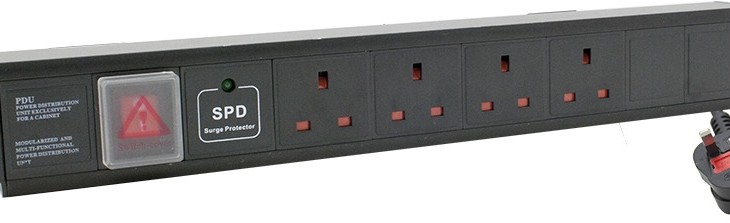
For businesses managing Stackable Switches or servers, a surge-protected Power Distribution Unit (PDU) is mandatory. These provide clean power across 8 to 12 outlets while fitting seamlessly into a 19-inch rack.
3. Best for Total Peace of Mind: UPS Systems
While SPDs stop spikes, a UPS (Uninterruptible Power Supply) handles brownouts and total blackouts.
- Recommendation: Combine an SPD with an APC or Eaton UPS for 360-degree power conditioning.
How to Install and Maintain Your SPD
- Identify Vulnerable Gear: Prioritize items with data connections, like Ethernet Switches and NAS drives.
- Check the Grounding: Surge protectors only work if your building’s earthing is functional.
- Monitor the LED: Most units have a “Protected” LED. If this light goes out, the internal MOV has sacrificed itself to save your gear—replace the unit immediately.
- Don’t “Daisy Chain”: Never plug one surge protector into another; this creates a fire hazard and voids warranties.
Expert Verdict
In 2026, the cost of a single Category 6 Ethernet lead is negligible, but the cost of replacing a fried 24-port PoE switch is massive. We recommend a layered approach: Use a Type 2 SPD at your consumer unit and Type 3 APC SurgeArrest units at every workstation.
Frequently Asked Questions (FAQ)
Do I need a surge protector if I have a UPS?
Yes. While many UPS units include basic surge suppression, dedicated SPDs often have higher Joule ratings and better clamping voltages for extreme spikes.
How often should I replace my surge protector?
Every 2-3 years, or immediately after a major electrical event (like a nearby lightning strike).
Can an SPD protect against a direct lightning strike?
No device can guarantee 100% protection against a direct hit, but a Type 1 SPD significantly increases the chances of your infrastructure surviving the secondary surge.
Shop the Full Range at Comms Express
Browse the UK’s most trusted brands and high-performance infrastructure solutions.
- Cabling & Racks
- Buy Network Cables
- Shop RJ45 Patch Leads
- Buy Patch Panels
- Shop Cat6 Cable
- Buy Fibre Patch Leads
- Shop Server Racks
- Buy Data Cabinets
- Networking & Power
- Shop Network Switches
- Buy UPS Systems
- Shop Rack PDUs
- Buy IP CCTV & Cameras
- Offers & Savings
- Shop Discounts
- Buy Multi-Buy Offers
- Our Top Brands
- Shop Ubiquiti | Buy TP-Link
- Shop Cisco | Buy Netgear
- Shop DrayTek | Buy D-Link
- Shop HPE Aruba | Buy APC
- Shop Teltonika | Buy Eaton
- Shop Excel | Buy Lindy
- Own Brands
- Shop Datacel | Buy CE Networking
Project Planning? Get expert technical advice and custom quotes for large installations. Contact our expert sales team today.