
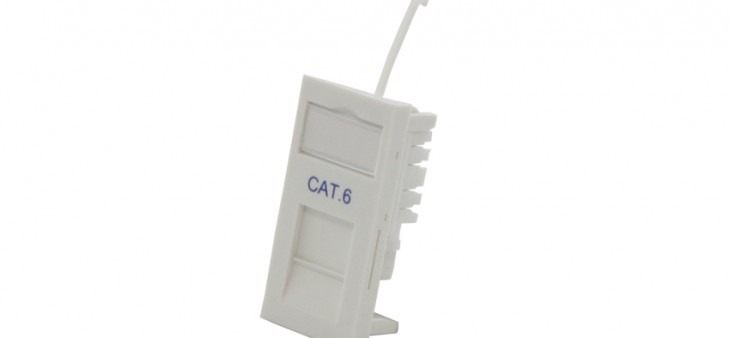
Key Takeaway: A punch-down module is a telecommunications component used to terminate copper wiring (Cat5e, Cat6, or telephony) into a permanent connection.
- It utilizes Insulation-Displacement Connectors (IDC), where a metal blade pierces the wire’s insulation to make contact with the conductor, removing the need to strip wires manually.
- The two primary types are 110 punch-down (common in US/Data) and Krone-style (common in UK/Europe).
- Found on the rear of patch panels, inside wall modules, and within telephone distribution frames.
How does an Insulation-Displacement Connector (IDC) work?
- IDC technology is the “engine” inside a punch-down module.
- Instead of stripping the plastic jacket off each individual copper strand, the wire is forced into a narrow metal V-shaped slot.
- As the wire is “punched” into the slot, the blades cut only the insulation to create a cold-welded, gas-tight connection. This ensures high signal integrity and speeds up installation in high-density environments.
Krone vs. 110 Punch-Down: What is the difference?
- While both are IDCs, they require different tools and feature different contact geometries.
- Using the wrong tool on a module can permanently damage the metal contacts.
- 110 Style: Usually features vertical contacts. It is the dominant standard for data networking and patch panels.
- Krone Style: Features contacts set at a 45-degree angle. It is the European and UK standard, widely used in both telephony and data modules.
Essential Tools for Punch-Down Termination
- To terminate a wire correctly, a dedicated impact or non-impact punch-down tool is required.
- These tools perform two actions simultaneously: seating the wire into the IDC and trimming the excess copper.
- Adjust the pressure based on the wire gauge to ensure a clean cut without damaging the plastic housing.
- Always ensure the “cut” side of the blade is facing the outside of the module to avoid cutting the live signal side of the wire.
Frequently Asked Questions (FAQ)
Can I use a 110 tool on a Krone module? No. Krone contacts are angled at 45 degrees, whereas 110 contacts are straight. Using a 110 tool on a Krone module can bend the contacts, leading to poor connections or permanent hardware failure.
Is it better to use solid or stranded wire for punch-down? Punch-down modules and IDCs are specifically designed for solid core cable. Stranded wire is too flexible and may not be properly pierced by the IDC blades, leading to intermittent signal loss.
What is a “Gas-Tight” connection? A gas-tight connection occurs when the IDC blade exerts enough pressure on the copper conductor to exclude oxygen. This prevents oxidation at the contact point, ensuring the connection remains stable for years.
Get Expert Technical Advice
Still unsure which specification suits your project? The experts at Comms Express are available to provide bespoke recommendations for residential, commercial, or industrial deployments.
Browse our full range of Punch Down Tools contact our team for a bulk-buy quote today.
Shop the Full Range at Comms Express
Browse the UK’s most trusted brands and high-performance infrastructure solutions.
- Cabling & Racks
- Buy Network Cables
- Shop RJ45 Patch Leads
- Buy Patch Panels
- Shop Cat6 Cable
- Buy Fibre Patch Leads
- Shop Server Racks
- Buy Data Cabinets
- Networking & Power
- Shop Network Switches
- Buy UPS Systems
- Shop Rack PDUs
- Buy IP CCTV & Cameras
- Offers & Savings
- Shop Discounts
- Buy Multi-Buy Offers
- Our Top Brands
- Shop Ubiquiti | Buy TP-Link
- Shop Cisco | Buy Netgear
- Shop DrayTek | Buy D-Link
- Shop HPE Aruba | Buy APC
- Shop Teltonika | Buy Eaton
- Shop Excel | Buy Lindy
- Own Brands
- Shop Datacel | Buy CE Networking
Project Planning? Get expert technical advice and custom quotes for large installations. Contact our expert sales team today.