
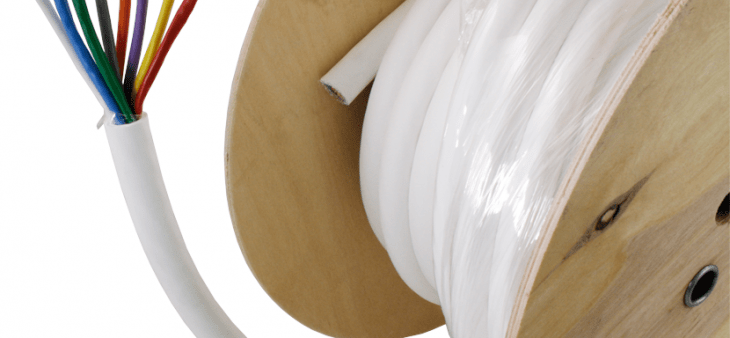
Twisted pairs are made up of two insulated copper wires that are twisted together. The twisting is done to help cancel exterior electromagnetic interference. Crosstalk interference can come from other pairs within a cable. Each type of twisted pair cable has bandwidth and data rate specifications. Due to its thinner diameter, a twisted wire is often found in telephone or network cables. Coaxial or optical fibre options deliver greater bandwidth in comparison to twisted pair cabling. Twisted pair is often for home use, though higher twisted pair grades can be used for LAN installs.
In the world of structured cabling, twisted pair cables remain the backbone of almost every local area network (LAN). From small home offices to sprawling data centres, understanding the nuances between different copper cable types is essential for ensuring network stability and high-speed data transmission.
What is a Twisted Pair Cable?
A twisted pair cable consists of two separate insulated copper wires, which are twisted together and run parallel to one another. This “twist” is not for aesthetics; it is a critical engineering feature designed to reduce electromagnetic interference (EMI) and “crosstalk” from adjacent pairs.
By twisting the wires, the magnetic fields created by the electrical signals cancel each other out, ensuring a cleaner, more reliable signal over longer distances.
UTP vs. STP: Which One Do You Need?
When browsing Network Cables, you will encounter two primary construction types:
-
Unshielded Twisted Pair (UTP): The most common type of networking cable. It relies solely on the cancellation effect of the twisted pairs to handle interference. It is flexible, cost-effective, and ideal for standard office environments.
-
Shielded Twisted Pair (STP/FTP): These cables feature an additional layer of foil or braided shielding to protect against heavy EMI. You should use shielded cables in environments with high electrical noise, such as near power cables or in industrial settings.
Understanding Ethernet Categories
Copper cabling is rated by “Category” (Cat), which defines its frequency and maximum data speed. Choosing the right category is the first step in future-proofing your infrastructure.
| Category | Max Speed | Bandwidth | Best Use Case |
| Cat5e | 1 Gbps | 100 MHz | Budget-friendly home networking. |
| Cat6 | 1 Gbps* | 250 MHz | The modern standard for business LANs. |
| Cat6a | 10 Gbps | 500 MHz | High-speed data centres and future-proofing. |
| Cat7 / Cat7a | 10 Gbps+ | 1000 MHz | Specialist industrial or AV applications. |
*Cat6 can support 10Gbps over shorter distances (up to 55m).
Solid Core vs. Stranded Copper Cables
The internal structure of the copper determines where the cable should be used:
-
Solid Core Cable: Features one solid copper wire per conductor. It is designed for “permanent” installations, such as running through walls or under floors. It offers better signal strength over long distances but is less flexible.
-
Patch Leads (Stranded): Made of multiple thin copper filaments. These are highly flexible and designed for “patching” devices like PCs, consoles, or switches to a wall socket or Patch Panel.
Common Uses for Twisted Pair Cables
-
Ethernet Networking: Connecting computers, printers, and servers to local networks.
-
Power over Ethernet (PoE): Providing both data and electrical power to devices like IP cameras and VoIP phones.
-
Telephone Systems: Utilizing standard Telephone Cables for voice communications.
-
Audio/Visual: Sending high-definition video signals over long distances using HDBaseT technology.
Frequently Asked Questions (FAQ)
What is the maximum length for a twisted pair cable?
The industry standard for all copper Ethernet cables (Cat5e to Cat6a) is 100 metres. Beyond this length, the signal degrades, and you may require a network switch or a transition to Fibre Optic Cabling.
Why should I avoid CCA (Copper Clad Aluminium) cables?
CCA cables are made of aluminium coated in a thin layer of copper. They are brittle, perform poorly, and can be a fire hazard when used with PoE. At Comms Express, we only supply 100% Pure Copper to ensure safety and reliability.
Do I need shielded cable for my home?
For 95% of residential applications, UTP (unshielded) is more than sufficient. You only need shielded cable if you are running your network lines directly alongside high-voltage mains power cables.
Twisted Pair Cable in Stranded or Solid Versions
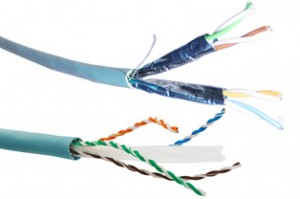
When two wires with separate insulation are twisted around one another, twisted pair cable is the result. The cable is available in solid or stranded versions. Stranded wiring offers greater flexibility for installs that require bending. Solid wiring, also known as solid core cable, can cover more distance but is not designed for installs that require physical flexing. Both the shielded and unshielded twisted pairs are available in solid or stranded variations.
STP and UTP Characteristics
A shielded twisted pair and unshielded twisted pair are abbreviated as STP and UTP. STP features two insulated copper wires that are twisted around one another and then covered with an additional shield. This extra covering boosts interference protection. STP is often utilized in Ethernet applications. UTP cables are a popular cable choice for LANs. It is comprised of two twisted wires without any shielding. Noisier environments benefit from STP. Comms Express specializes in all types of cable for network connections, including twisted-pair wiring.