
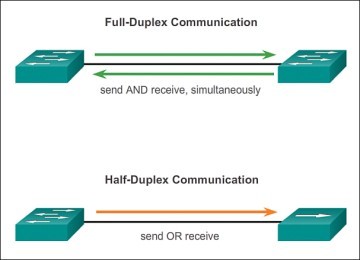
The term duplex, on its own, refers to the capability to send and receive data. Duplex is often used when talking about conversations over a telephone or computer. A full-duplex Ethernet environment can use a pair of twisted cable for packet receiving and a pair of twisted cable for transmission.
Half-Duplex Devices
Half-duplex devices can only transmit in one direction at one time. So although data can move in two directions, it cannot be at the same time. Both devices are capable of transmitting and receiving so when one device is sending, the other is receiving. A pair of walkie-talkies is an example of this because communications are sent both ways but can only be transmitted one at a time.
Full-Duplex Devices
The term full-duplex describes simultaneous data transmission and receptions over one channel. A full-duplex device is capable of bi-directional network data transmissions at the same time. Where communication from both devices is required at all times, this mode is used. For example, telephone networks are made up of full-duplex devices to allow simultaneous transmitting and receiving.
Full/Half-Duplex Devices
In data communications, the full/half-duplex device allows users to choose either full or half-duplex modes. With half-or-full duplex devices, such as modems, a switch will be set to either full or half mode. The mode can be modified to correspond with each specific type of communication program. When set to a half-duplex system, connections alternate use of the communication channel and hardware can determine the time each data link in the system is allotted for transmissions.
Differences Between Full and Half-Duplex Systems
There are distinct differences between full and half-duplex systems. With half-duplex mode, each transmitted character is immediately displayed on a monitor. If a device is operating in full-duplex mode, transmitted data does not appear on-screen until it is received and returned. Full-duplex Ethernet does save time when compared to half-duplex because it alleviates collisions and frame retransmissions. Sending and receiving are separate functions, creating a system where there is full data capacity in each direction. In contrast, half-duplex can be used to conserve bandwidth.
|
|
|
|
Bidirectional (one at a time) |
Bidirectional (simultaneously) | Unidirectional |
| Sender can send and receive data separately | Sender can send and receive data at the same time |
Data can only be sent |
| Used to conserve bandwidth when only single communication is needed | Used when communication is required in both directions without any delay |
When maximum bandwidth is required for the transmission and only one direction is required |
Get Expert Technical Advice
Still unsure which specification suits your project? The experts at Comms Express are available to provide bespoke recommendations for residential, commercial, or industrial deployments.
Next Step: Browse our full range of RJ45 Ethernet Cables or contact our team for a bulk-buy quote today.
Shop the Full Range at Comms Express
Browse the UK’s most trusted brands and high-performance infrastructure solutions.
- Cabling & Racks
- Buy Network Cables
- Shop RJ45 Patch Leads
- Buy Patch Panels
- Shop Cat6 Cable
- Buy Fibre Patch Leads
- Shop Server Racks
- Buy Data Cabinets
- Networking & Power
- Shop Network Switches
- Buy UPS Systems
- Shop Rack PDUs
- Buy IP CCTV & Cameras
- Offers & Savings
- Shop Discounts
- Buy Multi-Buy Offers
- Our Top Brands
- Shop Ubiquiti | Buy TP-Link
- Shop Cisco | Buy Netgear
- Shop DrayTek | Buy D-Link
- Shop HPE Aruba | Buy APC
- Shop Teltonika | Buy Eaton
- Shop Excel | Buy Lindy
- Own Brands
- Shop Datacel | Buy CE Networking
Project Planning? Get expert technical advice and custom quotes for large installations. Contact our expert sales team today.