










| Product Code: | |
| Options: | |
| Qty: | |
| Unit Price: | £ |

| Part No: | HPJ9050A |
| Manufacturer No: | J9050A |
| Delivery: | End of Life Product |


 |
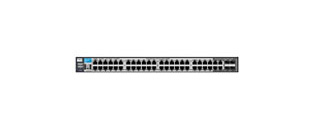
The ProCurve Switch 2900 series consists of two switches: the ProCurve Switch 2900-24G with 24 10/100/1000 ports and the ProCurve Switch 2900-48G with 48 10/100/1000 ports. Both have 4 dual-personality ports for 10/100/1000 or mini-GBIC connectivity. In addition, by including four integrated 10-Gigabit Ethernet (two CX4 ports and two X2 slots), the 2900 series offers the most flexible and easy-to-deploy multiple 10-Gigabit stacking and uplinks in its class. Together with IP static & RIP routing, robust security and management features, free lifetime warranty, and free software updates, the 2900 series is a cost-effective, future-proof solution for customers who are building high-performance networks.
| Technical features | |
|---|---|
| External I/O ports | 44 10/100/1000 ports (IEEE 802.3 Type 10Base-T, IEEE 802.3u Type 100Base-TX, IEEE 802.3ab 1000Base-T Gigabit Ethernet); 2 CX4 10-GbE ports, 2 X2 ports; 1 RS-232C DB-9 console port; 4 dual-personality ports - each port can be used as either an RJ-45 10/100/1000 port (IEEE 802.3 Type 10Base-T; 802.3u Type 100Base-TX; 802.3ab 1000Base-T Gigabit Ethernet) or an open mini-GBIC slot (for use with mini-GBIC transceivers) |
| Rack mounting | Mounts in an EIA-standard 19 in. telco rack or equipment cabinet (hardware included); horizontal surface mounting only |
| Memory and processor | Processor: Freescale PowerPC 8540 @ 667 MHz processor; Packet buffer size: 22.5 MB; Flash Capacity: 4 MB |
| Latency | 1000 Mb |
| Address table size | 2,000 entries |
| Routing/switching capacity | 148 Gbps |
| Throughput | up to 110 million pps |
| Management features | ProCurve Manager Plus; ProCurve Manager (included); command-line interface; Web browser; configuration menu; out-of-band management (serial RS-232C) |
| Communications | RFC 783 TFTP; RFC 951 BootP; RFC 854 Telnet; RFC 768 UDP; RFC 792 ICMP; RFC 793 TCP; RFC 826 ARP; RFC 2030 SNTP; IEEE 802.3x Flow Control; DHCP Relay; RFC 3046 DHCP Relay Agent Information Option 82; RFC 3376 IGMPv1/v2/v3; RFC 2453 RIPv2; IEEE 802.1D Spanning Tree; IEEE 802.1w Rapid Convergence Spanning Tree; IEEE 802.1s Multiple Spanning Trees; IEEE 802.3ad Link Aggregation Control Protocol; IEEE 802.1AB Link Layer Discovery Protocol; ANSI/TIA-1057 LLDP Media Endpoint Discovery (MED); RFC 2474 DiffServ Precedence; RFC 2598 DiffServ Expedited Forwarding (EF); RFC 2597 DiffServ Assured Forwarding (AF); RFC 1492 TACACS+; RFC 2138 RADIUS; RFC 2866 RADIUS accounting; SSHv2 Secure Shell; Secure Sockets Layer (SSL); IEEE 802.1X Network Login; IEEE 802.1Q VLAN tagging; IEEE 802.1Q GVRP; IEEE 802.1p Priority; SNMPv1/v2c/v3; HTML and telnet management; RFC 1493 Bridge MIB; RFC 1213 MIB II; RFC 2737 Entity MIB; RFC 2863 Evolution of Interface; RFC 2665 Ethernet MIB; RFC 1058 RIP; RFC 1724 RIPv2 MIB; RFC 2819 Four groups of RMON: 1 (statistics), 2 (history), 3 (alarm) and 9 (events); XRMON; sFlow; RFC 2021 RMON probe configuration (RMON v2); RFC 2668 802.3 MAU MIB; RFC 2613 SMON; RFC 2674 802.1p and IEEE 802.1Q Bridge MIB; RFC 2618 RADIUS Client MIB; RFC 2620 RADIUS Accounting MIB; RFC 3046 DHCP Relay Agent Information Option |
| Power requirements | 100-127 VAC/200-240 VAC; 50/60 Hz |
| Power availability | 4.0/2.0 A |
| Power consumption | 200 W |
| Operating conditions | |
|---|---|
| Safety | CSA 22.2 No. 60950; UL 60950; IEC60950; EN60950 |
| Electromagnetic emissions | FCC Class A; EN55022/CISPR-22 Class A; VCCI Class A |
| Operating temperature range | 0° to 55° C |
| Operating humidity range | 15 to 95% |
The ProCurve Switch 2900 series consists of two switches: the ProCurve Switch 2900-24G with 24 10/100/1000 ports and the ProCurve Switch 2900-48G with 48 10/100/1000 ports. Both have 4 dual-personality ports for 10/100/1000 or mini-GBIC connectivity. In addition, by including four integrated 10-Gigabit Ethernet (two CX4 ports and two X2 slots), the 2900 series offers the most flexible and easy-to-deploy multiple 10-Gigabit stacking and uplinks in its class. Together with IP static & RIP routing, robust security and management features, free lifetime warranty, and free software updates, the 2900 series is a cost-effective, future-proof solution for customers who are building high-performance networks.
| Technical features | |
|---|---|
| External I/O ports | 44 10/100/1000 ports (IEEE 802.3 Type 10Base-T, IEEE 802.3u Type 100Base-TX, IEEE 802.3ab 1000Base-T Gigabit Ethernet); 2 CX4 10-GbE ports, 2 X2 ports; 1 RS-232C DB-9 console port; 4 dual-personality ports - each port can be used as either an RJ-45 10/100/1000 port (IEEE 802.3 Type 10Base-T; 802.3u Type 100Base-TX; 802.3ab 1000Base-T Gigabit Ethernet) or an open mini-GBIC slot (for use with mini-GBIC transceivers) |
| Rack mounting | Mounts in an EIA-standard 19 in. telco rack or equipment cabinet (hardware included); horizontal surface mounting only |
| Memory and processor | Processor: Freescale PowerPC 8540 @ 667 MHz processor; Packet buffer size: 22.5 MB; Flash Capacity: 4 MB |
| Latency | 1000 Mb |
| Address table size | 2,000 entries |
| Routing/switching capacity | 148 Gbps |
| Throughput | up to 110 million pps |
| Management features | ProCurve Manager Plus; ProCurve Manager (included); command-line interface; Web browser; configuration menu; out-of-band management (serial RS-232C) |
| Communications | RFC 783 TFTP; RFC 951 BootP; RFC 854 Telnet; RFC 768 UDP; RFC 792 ICMP; RFC 793 TCP; RFC 826 ARP; RFC 2030 SNTP; IEEE 802.3x Flow Control; DHCP Relay; RFC 3046 DHCP Relay Agent Information Option 82; RFC 3376 IGMPv1/v2/v3; RFC 2453 RIPv2; IEEE 802.1D Spanning Tree; IEEE 802.1w Rapid Convergence Spanning Tree; IEEE 802.1s Multiple Spanning Trees; IEEE 802.3ad Link Aggregation Control Protocol; IEEE 802.1AB Link Layer Discovery Protocol; ANSI/TIA-1057 LLDP Media Endpoint Discovery (MED); RFC 2474 DiffServ Precedence; RFC 2598 DiffServ Expedited Forwarding (EF); RFC 2597 DiffServ Assured Forwarding (AF); RFC 1492 TACACS+; RFC 2138 RADIUS; RFC 2866 RADIUS accounting; SSHv2 Secure Shell; Secure Sockets Layer (SSL); IEEE 802.1X Network Login; IEEE 802.1Q VLAN tagging; IEEE 802.1Q GVRP; IEEE 802.1p Priority; SNMPv1/v2c/v3; HTML and telnet management; RFC 1493 Bridge MIB; RFC 1213 MIB II; RFC 2737 Entity MIB; RFC 2863 Evolution of Interface; RFC 2665 Ethernet MIB; RFC 1058 RIP; RFC 1724 RIPv2 MIB; RFC 2819 Four groups of RMON: 1 (statistics), 2 (history), 3 (alarm) and 9 (events); XRMON; sFlow; RFC 2021 RMON probe configuration (RMON v2); RFC 2668 802.3 MAU MIB; RFC 2613 SMON; RFC 2674 802.1p and IEEE 802.1Q Bridge MIB; RFC 2618 RADIUS Client MIB; RFC 2620 RADIUS Accounting MIB; RFC 3046 DHCP Relay Agent Information Option |
| Power requirements | 100-127 VAC/200-240 VAC; 50/60 Hz |
| Power availability | 4.0/2.0 A |
| Power consumption | 200 W |
| Operating conditions | |
|---|---|
| Safety | CSA 22.2 No. 60950; UL 60950; IEC60950; EN60950 |
| Electromagnetic emissions | FCC Class A; EN55022/CISPR-22 Class A; VCCI Class A |
| Operating temperature range | 0° to 55° C |
| Operating humidity range | 15 to 95% |
